
Union membership by the numbers
Union members earn better wages and benefits than workers who don’t belong to a union. According to the Bureau of Labor Statistics, union members’ wages are 30% higher than their nonunion counterparts. While only 14% of nonunion workers have guaranteed pensions, fully 68% of union workers do. More than 97% of union workers have jobs that provide health insurance benefits; only 85% of nonunion workers do. Unions help employers create a more stable, productive workforce — where workers have a say in improving their jobs.
Unions provide real protection at work
Only a union can provide you real employment protection. Under the “employment at will” doctrine, the cornerstone of U.S. employment law, unless you belong to a protected group, your employer has the right to discipline or terminate you, with impunity, for any reason — even a bad one — or for no reason at all. With a collective bargaining agreement, you have rights spelled out in a contract. Management must have “just cause” for any disciplinary action taken against a union employee. “Just cause” is spelled out in our union contract so that we know exactly what is expected of us, and management knows exactly what is required of them.
How much more do union members make?
Union membership brings many benefits to working people, one of which is weekly earnings. The data below show that union workers, on average, made $161 or 27% more per week than nonunion workers in 2003. Furthermore, when broken down to both industries and occupational categories, the union difference becomes even clearer.
WEEKLY EARNINGS ADVANTAGE FOR UNION MEMBERS, 2025 Full-Time Wage and Salary Workers’ Median Weekly Earnings
| Union | Nonunion | Union Weekly Advantage | |
| All Workers 16 and Over | $1,404 | $1,174 | $230 |
| Race and Gender Breakdown | |||
| White, 16 years & over | $1,452 | $1,198 | $254 |
| Men | $1,538 | $1,325 | $213 |
| Women | $1,345 | $1,073 | $272 |
| Black, 16 years & over | $1,155 | $966 | $189 |
| Men | $1,230 | $1,012 | $218 |
| Women | $1,100 | $924 | $176 |
| Hispanic or Latino, 16 years & over | $1,233 | $920 | $313 |
| Men | $1,352 | $982 | $370 |
| Women | $1,160 | $864 | $296 |
| Industry Breakdown | |||
| Construction | $1,585 | $1,132 | $453 |
| Durable goods manufacturing | $1,401 | $1,282 | $119 |
| Nondurable goods manufacturing | $1,203 | $1,159 | $44 |
| Transportation & warehousing | $1,432 | $1,018 | $405 |
Note: In addition to the earnings benefits gained from being unionized, some of the union/nonunion differences may be due to factors such as employee skill level, region of the country and size of the employer.
Source: U.S. Department of Labor, Bureau of Labor Statistics, Median weekly earnings of full-time wage and salary workers by union affiliation and selected characteristics, 2024-2025 annual averages
You have better benefits as a union member.
Union workers are more likely than their nonunion counterparts to receive health care and pension benefits, according to the U.S. Department of Labor. While 69% of nonunion civilian workers have health care benefits, 96% of union civilian workers have access to health care benefits.
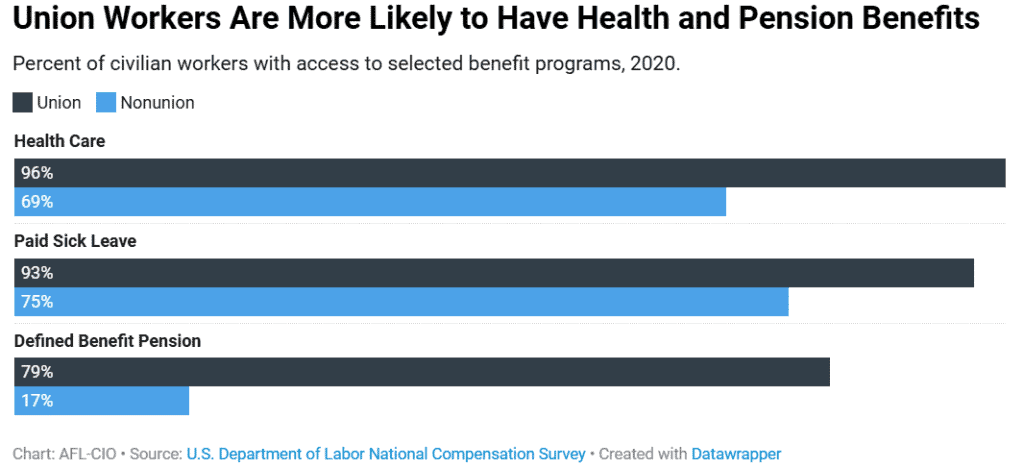
UNION WORKERS ARE MORE LIKELY TO HAVE HEALTH AND PENSION BENEFITS
As the chart illustrates, 79% of union workers have defined benefit pension plans versus 17% of nonunion workers. Defined-benefit plans are federally insured and provide a guaranteed monthly pension amount. They are better for workers than defined-contribution plans, in which the benefit amount depends on how well the underlying investments perform.
You have greater job stability as a union member.
Although 50% of union workers have been with their current employers for at least 10 years, only 32% of nonunion workers can make the same claim. Union workers have greater job stability, in part because they are more satisfied with their jobs, receive better pay, have better benefits and have access to fair grievance procedures. Even more important, most collective bargaining agreements protect union members from unjust discharge. Nonunion workers are “employees at will” who can be fired at any time for any reason – or for no reason.
Percentage of Workers with the Same Employer for 10 Years or More, 1998
Source: AFL-CIO analysis of the Current Population Survey

Become a SMART Member
Take the next step on your journey towards a rewarding career. Learn how you can become a SMART member.
Member Voices
Hear about the union directly from SMART members themselves.
SMART Sheet Metal Local 265 broke ground with maternity leave for members included within its benefits package. Danielle Wilson, a four year member of SMART, was one of the first to benefit from this new package.
