Critical railroad safety improvements are one step closer to becoming law in Pennsylvania after a bill cleared the state House of Representatives with bipartisan support.
Sponsored by Representative Rob Matzie (D-Beaver),House Bill 1191 would, among other things, prohibit trains from blocking crossings, limit train length to 8,500 feet, and require a minimum two-person crew (2-PC) on trains. The legislation also enforces proper functioning of wayside detector systems, a critical component in preventing derailments before they happen.
Bill is Part of a Nationwide Push for Rail Safety Legislation
Shortly after the third anniversary of the East Palestine derailment in February, multiple rail safety bills were filed in Congress to address lessons learned from the disaster so that history hopefully does not repeat itself.
As Representative Matzie explained in his remarks after the Pennsylvania House’s passage of the bill, “It’s been three years since the catastrophe in East Palestine. We can’t sit around and wait for that to happen again. [This bill] is a way we can start to reduce derailments and protect workers, first responders and community residents.”
This is the second time in three years that Representative Matzie has introduced rail safety-related legislation; a similar bill passed the House in 2023 but was never voted on in the Senate.
“It’s Time for the Senate to Step Up and Take Action”
As the bill awaits its first hearing in the State Senate, which will take place in the Consumer Protection & Professional Licensure Committee, Representative Matzie is calling on his fellow lawmakers in the upper chamber to act and take an important step forward to improve rail safety in the Commonwealth.
“Nothing has really changed since the 2023 accident, and there is every indication that resolutions to these problems will be left up to the states,” Matzie said. “It’s time for the Senate to step up and [take action].”
Not many who belong to SMART-TD can say that they’ve been a member for 50 years, but Brother Robert “RC” Hailes (Local 854, Portsmouth, Va.) is one of the few who can claim that honor.
To celebrate this major milestone, the Norfolk & Portsmouth Beltline Railroad (NPBL) changed the name of a rail yard in Portsmouth to “Hailes Yard” to recognize his five decades of service.
Brother Hailes has worked on the NPBL Railroad for his entire career, starting out as a brakeman before moving into the role of conductor. He currently works as a Yardmaster and, according to Virginia State Safety & Legislative Director Ronnie Hobbs, has no plans to retire any time soon.
SLD Hobbs says that RC shows exemplary leadership qualities to SMART-TD members in both the Commonwealth and across the country.
Congratulations, Brother Hailes! Thank you for dedicating half a century of service to our union!
Women’s History Month is not about looking back. It is about recognizing the history being written right now by the women of our union. Across rail and transit, our sisters are not waiting for their place in history to be recorded. They are actively shaping it through courage, resilience, and leadership.
Sister Heather Steele (Local 168, Chicago, Ill.) is one of those women.
A conductor for Amtrak and a SMART-TD member since late 2012, Steele comes from a proud railroad family that dates back three generations. Her father, Jack, retired from Amtrak after working in mechanical airbrakes and welding. He also worked in the employee training center for a few years. Heather’s brother, Wallace, is an engineer with Amtrak based out of Indianapolis, and her grandfather worked for Amtrak. That deep legacy of commitment to the craft and to the people who make the industry run is something Steele carries with her every day.
Strength in the Face of Adversity
Just last month, SMART-TD shared a difficult part of Heather’s story. In August of 2024, she experienced a brutal on-duty assault that changed the course of her life. The physical, emotional, and financial toll continues to be significant, not just for Heather but for her young family as well.
But if there is one thing that Heather’s whole story makes clear, it’s that she is not about to be defined by what happened to her.
When SMART-TD members were asked to rally around Heather and her family, they answered in a powerful way. The GoFundMe Local 168 put together has raised nearly $23,000 to support her during a difficult time. That outpouring of solidarity speaks to the strength of this union. But it also speaks to something else: the impact of Heather’s story.
Because her story didn’t end on that dark day in 2024.
In the months since SMART News shared Heather’s story, Sister Steele has made a decision that embodies what Women Making History Month is all about. Working alongside SMART-TD’s Bus and Transit Assault Prevention and Safety (BTAPS) Committee and the union’s National Safety and Legislative Department, she has chosen to step forward. Not just as a survivor or as a victim, but as an advocate.
Taking the Fight to Washington
Right now, there is a bill in Congress known as the Passenger Rail Crew Protection Act, introduced by Senators John Hoeven (R-North Dakota) and Tammy Duckworth (D-Illinois). The legislation is designed to strengthen protections for passenger rail crews and help prevent the kind of incidents that have impacted too many transportation workers from coast to coast.
After careful consideration, Heather believes in the purpose of this bill and in its ability to make a real difference in the safety of transit professionals.
Now, she is preparing to take that belief to Washington, D.C.
In the coming weeks, Sister Steele will meet with lawmakers and their staff to share her perspective and help build support for the legislation. These are not easy conversations. Walking into those rooms carries a lot of weight. She won’t just be standing up for herself, but for every man and woman affected by the epidemic of transit violence. She will be speaking both for herself and for her fellow conductors, her union brothers and sisters, and the generations who will follow.
Still Moving Forward
Sister Steele is a Vice Local Chairperson in Local 168, but this kind of responsibility doesn’t come with the VLC job description.
It requires a lot of courage.
Even as she continues intensive physical therapy five days a week, Steele is making time to prepare for this next chapter. She is navigating recovery, family life, and now the national stage, all while staying grounded in her commitment to her craft and her union.
This is what leadership looks like.
It is not always found in titles or positions. Sometimes, it is found in the willingness to step forward when it matters most, or to turn personal hardship into collective progress.
Heather Steele is doing exactly that.
She is helping drive a conversation about safety in the transportation industry, lending her voice to an effort that aims to protect not just today’s workforce, but tomorrow’s as well. Her work on The Hill has the potential to leave a lasting impact on this union.
And she’s not done.
Steele remains focused on returning to the career she loves, continuing her recovery with determination and purpose. At the same time, she is embracing the opportunity to contribute to something bigger. She is becoming the face of the movement to help strengthen protections that could benefit railroaders across the country.
That is why SMART-TD doesn’t simply observe Women’s History Month.
We celebrate Women Making History Month.
Because sisters like Heather Steele are not waiting for history to catch up or notice them. They are building it in real time.
Through strength. Through solidarity. Through action.
And through an unwavering commitment to making this industry safer and stronger for all.
After spending more than 30 years as an engineer for the Canadian Pacific and serving SMART-TD brothers and sisters in Wisconsin, Brother Steve James (Local 590, Portage, Wis.) officially retired on December 1, 2025.
As both the Safety & Legislative Representative for Local 590 and the secretary for the Wisconsin Legislative Board led by State Director Andy Hauck, Brother James played a critical role in advancing the interests of railroaders in his home state for years.
A generational railroader who is held in high regard by the membership in Wisconsin, he received two special gifts of recognition upon his retirement.
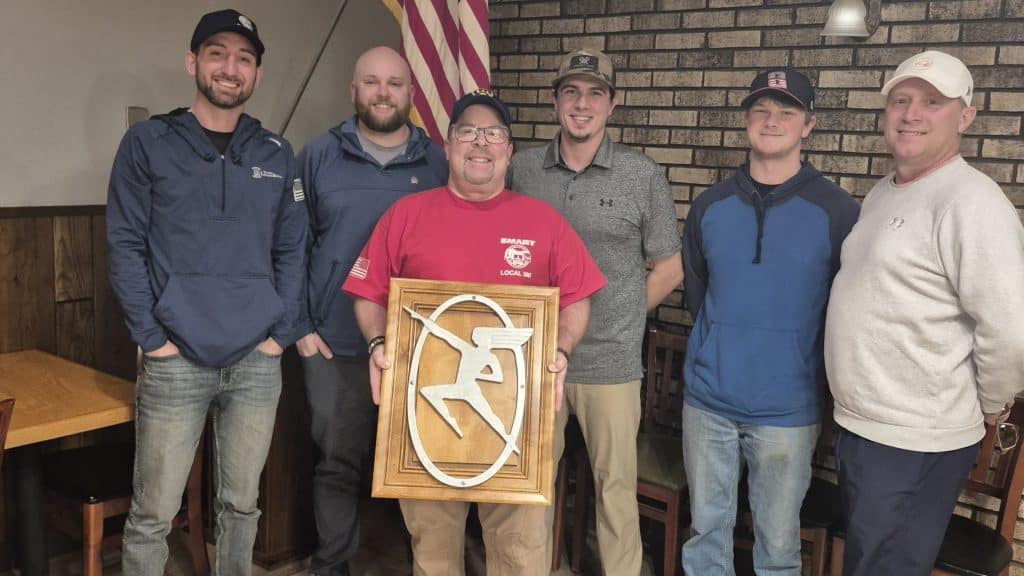
Local 590 presented Brother James with a SMART-TD watch, and the Wisconsin State Legislative Board gave him an emblem from the storied Milwaukee Road Hiawatha Service.
Brother Steve James (third from left) is presented with the Milwaukee Road Hiawatha Service emblem to mark his retirement.
Reflecting on Brother James’s years of service, Wisconsin SLD Andy Hauk said that “Steve is a magnificent example of an officer that is all about service to his members…[and] will be sorely missed by all of us!”
In his retirement message, Brother James shared a similar fondness for those who he served for many years, saying “It has been quite an honor…to serve with all of you in these positions. Little did I know what I was getting into when, many years ago, I raised my hand at my local meeting and threw my hat in the ring for Alternate Legislative Representative for 590!”
Best wishes on your well-deserved retirement, Brother James, and thank you for your many decades of dedication to our union!
Retired railroad workers can now update their address and direct deposit information online, saving valuable time as the U.S. Railroad Retirement Board (RRB) works to modernize its systems for a digital world.
To do so, retirees must sign into myRRB at RRB.gov/myRRB and click on “Change my Address” to update their mailing address or “Manage My Direct Deposit” to add or update their direct deposit information. Please note that a Login.gov account is required to access all myRRB services, and the agency encourages all railroad employees to verify their identities with Login.gov.
In addition to these new features, myRRB also offers the ability to…
These new online services are currently only available to retired railroad workers who receive a monthly annuity from the RRB. Retired spouses or other annuitants must contact their local RRB field office to make any changes to their address or direct deposit information.
The RRB says that this project emphasizes the agency’s commitment to improve performance, expand services, and strengthen cybersecurity.
Over the past 36 years, Sister Kim Collier (Local 1857, Green River, Wyo.) has learned firsthand that it takes a special kind of person to work on the railroad.
Whether it’s being on call 24/7, working in the yard in the middle of the night, or descending on the State Capitol in Cheyenne to talk with lawmakers about the most significant issues facing rail workers, there’s nothing she hasn’t seen.
“It’s men and women…you definitely have to be able to handle your own,” she told SMART News in an interview. “Common sense, first and foremost. Can you make a decision without [questioning it]? You can make this job very hard, or it could be the easiest job out there.”
Her words of wisdom don’t come lightly: they’re born from more than three decades on the rails, the experiences she’s had, and the knowledge she’s gained along the way.
A Pause During College Leads to a Major Career Change
After graduating from high school, Sister Collier planned to go to college but wanted to take a break first, even though her mom wasn’t thrilled with that idea.
She ended up going to college for two years as a double major in chemistry and zoology with a pre-med focus before going back to her original plan.
Remembering the conversation at the time, she said “Look, I’m paying for all this. I’m taking a break. That way I get some money saved up and not be frazzled at the other end of it.” She took the long-awaited break but ended up working three jobs at the same time.
One day at work, she got a call from her dad who was a conductor based out of Rawlins, Wyo. This was something he never did, so she was convinced that something was wrong.
Fortunately, Sister Collier was wrong: her dad told her that one of the big names at Union Pacific wanted to see her in his office.
When she got there, she was asked one direct question: if Sister Collier were on her dad’s turn, would he give her preferential treatment? Her response: “You don’t know him very well if you’re asking that question, and I’d ask to be the first one out the door doing the job.”
That was the answer he wanted to hear, and she was immediately sent to job services to fill out an application, even though they weren’t hiring. She had an interview two days later and the rest, she says, is on her.
A Legacy That Sister Collier Never Intended to Follow
If you ask Sister Collier if she ever thought she’d hire on the railroad, her response is very honest: never. Part of that is rooted in watching what her dad experienced while she was growing up.
“We never had Christmas on Christmas, but I think three times…whenever my dad was in,” she remembers. “Thanksgiving, the same thing. He never took any time off. He just worked constantly all the time until his vacations came.”
But when it came time to start her two weeks of class, his advice proved invaluable.
“My dad always told me ‘You have respect for this equipment out here. It will kill you in a heartbeat. It has no remorse.’”
More than three decades later, she’s the only one from her class who’s still working on the railroad.
Making Safety Her Personal Mission in the Yard and at the Capitol
One of Sister Collier’s many roles within our union is serving as the Wyoming Legislative Chairperson, whose state board is helmed by Safety & Legislative Director April Ford.
As she puts it, both were “kind of thrown into the fire” in their respective roles, but their complementary personalities and skills have made them a powerful force both at the Capitol and for our brothers and sisters in Wyoming.
“You give [April] something and she’s like a hound dog,” Sister Collier said laughing. “She just keeps on it and on it and on it. And I love that part of it. It’s a very good balance.”
At the Capitol, the women are focused on moving bills covering important issues like train length through the legislature, highlighting a particular passion for Sister Collier: safety.
“Safety is first and foremost in my book,” she emphasized. “All that stuff that was just overlooked [for so long].”
Considering the national spotlight on rail safety, she’s hopeful the bill will finally pass. But if nothing else, her conversations with lawmakers center on a simple question: are you with us or against us?
“It’s not Democrats and Republicans. It’s who’s with us or who’s against us,” she explained. “I think that’s a better way to look at things, because either you’re there for your safety or your health [or you’re not]. Almost 85% of all hazardous materials go through the I-80 corridor on the Union Pacific.”
Building a Bench of Strong Union Sisters Starts with Us
To bring more women into the transportation industry and our SMART-TD union family, Sister Collier points out that education needs to be at the center of that effort.
“What we could do is make more women realize what is out there,” she suggested. “A lot of them never even thought about the railroad.”
Even though the mission is still a work-in-progress, Sister Collier is optimistic based on what she’s seen over the past three decades.
“When you meet women at the union meeting and regionals and stuff like that, it’s like ‘Wow, we do have a bunch of women who are strong,’” she said. “We just need to find more.”
March 18 is National Transit Employee Appreciation Day, a day dedicated to the hardworking men and women who drive operate, and maintain public transit systems across the United States. This day honors the transit employees who keep our communities moving and serve as the most visible representatives of our union in cities and towns nationwide.
How Did National Transit Employee Appreciation Day Begin?
March 18 was chosen to honor the history of public transportation, because it marks the day in 1662 when public buses were first introduced in Paris, France. The modern era of public transit was born, ushering in a tradition of service and connectivity that has shaped cities and societies ever since.
In 2009, the day was first observed as National Bus Driver Appreciation Day in the United States. Five years later, the day was expanded to honor all transit employees, including those in passenger and commuter rail, becoming National Transit Employee Appreciation Day.
Honoring Service to the Transportation Industry and One Another
Our bus and rail workers face countless challenges in their daily shifts, from the pressures of tight schedules to the ongoing threat of violence in the workplace. Despite these difficulties, they continue to serve the public with professionalism, pride, and resilience.
We thank our Bus Operators, conductors, maintenance employees, and rail workers for their service to the transportation industry. But we also thank them for their exceptional service to one another through the strength of our union. Through collective advocacy and action, our voices are heard at every level. From local management to statehouses and Capitol Hill, the work our transit brothers and sisters perform shows why SMART-TD is the gold standard for representing transportation workers.
Leadership and Advocacy Set the Stage for a Stronger Future
In recent years, SMART-TD’s Bus Department has continued to build momentum. Our transit professionals have secured stronger protections, elevated their voices, and pushed forward meaningful quality of life and safety improvements in their workplaces.
One such initiative, the Bus Transit Assault Prevention and Safety (BTAPS) Committee, has worked tirelessly to advance safety, security, and respect for transit professionals.
SMART-TD President Jeremy Ferguson praised the role transit members play both on the job and in representing the union:
“Our transit members are the face of SMART-TD in communities across the country, and I couldn’t be more proud of the way they represent our union every day. Their professionalism and dedication do not go unnoticed. We remain committed, alongside our Bus Department, Amtrak and commuter rail General Committees, and BTAPS, to fighting for the safety, wages, job security, and respect our sisters and brothers have earned through their vital role in our communities and in the American labor movement.”
Santa Monica Big Blue Bus Operators Get a Shout-Out
Some of our SMART-TD brothers and sisters were featured in a short video celebrating Transit Worker Appreciation Day and highlighting what Big Blue Bus Operators do during each shift. Sister Markeisha Haynes and Brothers Enrique Guadian and Eddie Rodriguez walked Santa Monica Mayor Caroline Torosis through the many steps they take every day to ensure that passengers and their vehicles are safe while providing a vital service to the community.
We applaud Mayor Torosis for her support of public transportation and are proud of Sister Haynes and Brothers Guadian and Rodriguez for representing our union!
While National Transit Employee Appreciation Day is an important opportunity to reflect, our appreciation does not stop here.
This union celebrates our transit brothers and sisters every day. We recognize the work done, the challenges faced, and the professionalism displayed on the job. We are proud to stand beside you both in the workplace and in the cause.
Thank you for all that you do. Your contributions are invaluable, and we will continue to stand with you as we work toward a safer, more secure, and more just future for all transit workers.
In cities across the country, St. Patrick’s Day means more than celebration. It means tradition.
From Chicago to Boston, that tradition is rooted not just in those towns’ Irish heritage, but in the working-class spirit that helped build both the communities and the industries that sustain them.
This year marked the 48th consecutive Southside Irish Parade in Chicago, the longest continuously running St. Patrick’s Day parade in the country. For nearly five decades, it has honored the same values that define our union: hard work, solidarity, and pride.
State Senator Nick Collins (second from left), New England Safety & Legislative Director Dave Stevenson, and BTAPS Chairperson Cole Czub at the South Boston St. Patrick’s Day Breakfast.
At the same time, SMART representatives were in Boston attending the historic South Boston St. Patrick’s Day Breakfast hosted by State Senator Nick Collins. This event, with roots stretching back more than a century, has long been tied to both labor and public service.
SMART-TD members were proud to take part in both of these time-honored traditions. In Chicago, members participated in the parade for the third straight year, joined by SMART-TD President Jeremy Ferguson and SMART-TD Auxiliary President Kathryn Seegmiller.
SMART-TD President Jeremy Ferguson (fourth from left) and SMART-TD Auxiliary President Kathryn Seegmiller (center) at the Southside Irish Parade on Sunday, March 15, 2026.
A Tradition Built on Working-Class Pride
These two unique events have always stood apart. They aren’t about commercialization or spectacle. They’re about community: workers, families, tradition.
In cities like Chicago (one of America’s original rail hubs) and Boston (one of its oldest labor strongholds), the story of Irish Americans is inseparable from the rise of organized labor.
Tracks and Tradition
It’s well known that Irish immigrants helped build this country’s rail system under some of the toughest conditions imaginable. Irishmen came here in the 1800s and 1900s and found work laying track, working yards, and taking on dangerous jobs that others would not. They came looking for opportunity and found high risk at low pay.
Our organization was born out of those brutal conditions.
Irish American workers played a key role in the early American labor movement, helping shape the fight for fair wages, safer workplaces, and dignity on the job. These are the principles that still define SMART-TD and railroad unions today, from the tracks of Chicago to the union halls of Boston.
From left to right: BTAPS Chairperson Cole Czub, New England Safety & Legislative Director Dave Stevenson, and Massachusetts Governor Maura Healey.
Carrying It Forward
SMART-TD’s inclusion in the Southside Parade over the past three years reflects the deep connection between the Irish American worker and the rise of rail unions.
As Local 445’s Secretary Treasurer, Martin Bobrowski put it, “When the South Side parade committee first reached out about including our union, they made it clear they wanted to recognize the role Irish American workers played in building the rail industry and the unions that still protect it today. That’s something we’re proud to stand behind.”
That same connection was reflected in Boston, where SMART representatives, including SMART-TD Safety and Legislative Director for New England, Dave Stevenson, and BTAPS Chairperson Cole Czub, attended the South Boston St. Patrick’s Day Breakfast hosted by State Senator Nick Collins. Collins, who recently successfully sponsored a SMART-TD-endorsed transit assault bill in Massachusetts, made a point of recognizing the efforts of both SMART Sheet Metal and the Transportation Divisions at the event, alongside some of our labor partners and state leaders.
In Solidarity
For generations, our country’s St. Patrick’s Day traditions have honored a way of life grounded in hard work and unity.
SMART-TD is proud to be part of that legacy. Today and every day, we represent the workers who keep the transportation industry moving.
We would like to thank our Illinois State Safety and Legislative Board along with members of locals #445 (Chicago/Galesburg, IL & Fort Madison, IA), 1534 (Chicago, IL), 1929 (East St. Louis, IL), 1973 (Chicago, IL), Local 1202 (Fort Wayne, IN) and the General Committee of GC-009 for representing our union well again this year in Chicago.
A special thank you also goes to our Vice Local Chairperson of Local 445, Brother Rocco Sodin, who has organized SMART-TD’s participation in the parade since 2024. His efforts continue to make us successful.
These Saint Patrick’s Day events, from Chicago to Boston, are a strong example of SMART-TD bringing our message of the dignity and value of work and organized labor to the public.
And in that tradition, we don’t just honor the past. We carry it forward.
When Robin Smith (Local 830, Harrisburg, Pa.) was first approached about potentially working on the railroad, she laughed.
In the span of a few years, she moved from Michigan to Pennsylvania, got divorced, and was looking for a way to support her kids.
Her friend’s husband suggested that she put in an application to work with him on the railroad, which she decided to do after doing her research and learning more from him about what that would be like.
She was hired as a conductor for Norfolk Southern in 2010, became the first female officer of her local just two years later, and has never looked back while holding multiple leadership positions and becoming the go-to for new hires.
A Local Officer Who’s an Unofficial Mentor
Now an engineer who is currently both the Treasurer and Safety & Legislative Representative for Local 830, Sister Smith says that it was important to her to stay with both SMART-TD and her local for one big reason: ensuring the membership has a constant, dependable presence, especially when it comes to her union sisters.
“I feel like we’ve had so many changes in our local,” she explained. “Women communicate differently than men. I want them to know things. I want them to know their contract. I want them to know why we do certain things, and a lot of that stuff wasn’t getting out. So that kind of became my role.”
Over time, she’s also assumed the de facto role as a mentor to other females when they’re hired.
“As a female officer, when females are hired, I always try to reach out to them, make sure they have my number if they need anything, if they have questions,” she said. “It can be very lonely out there when you’re new.”
You don’t need to take Sister Smith’s word for it: her actions alone do the talking.
Smith Brings Solidarity and Sisterhood to Recent Hearing
When a recent disciplinary incident involving another female working for Norfolk Southern led to a formal hearing, Robin knew she couldn’t let her union sister sit in that room alone.
“As a female, those environments [hearings] and the investigation environment can be very intimidating,” she explained. “It’s uncomfortable, and anything can happen in that room. And as a female, we need to be there to support each other and to make sure that we’re not put in uncomfortable situations.”
In this case, it was one woman in a room with eight men. Sister Smith explains that even though some of those eight men present were supportive, they couldn’t necessarily relate to or understand what the female member was experiencing in that room.
“If you’re going to get emotional and you want to cry, then you need to have that person sit next to you that’s like ‘It’s okay, let’s take a break,’” she said. “You don’t have to keep going, because sometimes they just want to push through and get it done, and sometimes you need a break. So, I felt that she needed that person to be there to give her that break.”
“I feel like she felt like she was supported in her investigation and that she had people there to back her up and hear her, believe her, listen to her.”
General Chairperson of GCA 898 Tommy Gholson noticed that subtle but powerful solidarity in action from Sister Smith.
“During the hearing and recesses, [Robin provided a] shoulder and motherly care for the younger member,” he said. “It was very obvious to us that she is a role model to the female and membership alike in this area.”
Education and Knowledge Can’t Be Taken for Granted
Sister Smith explains that while the railroad industry is starting to change somewhat to bring more women into the fold, she’s optimistic that even more can be done.
“I think visibility is a big thing,” she said. “It’s not a physical job. It’s knowledge. We need to educate people and make women more visible and actively promote hiring more women.”
That goal is especially personal since her daughter, who is a single mom, just put in an application herself.
“It’s a good career with good benefits, with good retirement, and the ability to provide for your children on your own.”
But regardless of whether a new hire is male or female, Sister Smith emphasizes one thing above all else: education.
“Everybody needs to be educated,” she explained. They need to know who to contact, who to communicate with when they have incidents and when things happen, and they need to make sure they get their documentation and get everything in writing.”
As she’s learned firsthand, that knowledge makes all the difference.
“[I used to think] I’m just grateful to have the job,” she said. “I am grateful to have the job. But you know what? I’m grateful to help you and help me protect my job, because that’s the important part. You have to protect the job.”
Railroading hasn’t always been an industry full of women, but our sisters who are here today are making sure it won’t always be that way. In crew rooms, on locomotives, and in heated hearing rooms, sisters like Robin Smith are writing the story of women in railroading in real time. When union sisters show up for each other, support each other, and share the knowledge that keeps us all protected, they’re not just recognizing women’s history: they’re forging it.
A NOTE FROM SMART NEWS: As we celebrate Women’s History Month, SMART-Transportation Division will once again feature stories highlighting some of our fellow sisters and their contributions to their craft and our union. Our first story in the series is particularly special and one that we are excited to share: it was written by a member’s daughter to show how proud she is of her mother’s accomplishments and leadership. We invite you to meet Sister Sandra Pineda, whose story is told with love and pride by her daughter, Gabby Grace Venegas. This article has been slightly edited for clarity.
I am honored to write this article for my mother, who has shown me that loving our Lord, hard work and dedication to others are not just valued, but a way of life.
For more than two decades, my mom has built a career defined by dedication, service, and an unwavering commitment to others. What began as a mission to provide financial stability for her three daughters has grown into a legacy of leadership within LACMTA and SMART-TD. Through her work as a bus operator, union leader, advocate, and mentor, she has consistently stepped forward to support those around her.
My mom began working for Metro 23 years ago as a single mother determined to create a stable and secure home for our family. With two older brothers already employed by the company, she joined Metro and quickly demonstrated the work ethic and resilience that would define her career. She worked 20 years full-time and three years part-time, balancing long hours with the unexpected challenges that come with life as both a transit operator and a single parent. No matter the circumstances, her focus remained the same: to provide for her daughters and build a future rooted in opportunity.
She also dedicated five years to the LACMTA Coffee Club Committee, strengthening workplace community and connection. Through this involvement, she built meaningful relationships and earned the trust and support that later helped her secure election as SMART-TD Local Secretary 1563. And if you know my mom, you know she is going to make sure you enjoy a good meal! Her generosity and hospitality are just as strong as her advocacy.
During her time as a bus operator, she saw firsthand how quickly accidents and hardship could affect her coworkers. Whether injuries occurred on or off the job, many operators were left navigating uncertainty and financial stress. Recognizing the need for strong, trustworthy leadership, she ran for SMART-TD Local Secretary 1563. For the past 12 years, she has served in this role with unmatched dedication.
Her commitment to others extends beyond office hours. With the support of my stepdad, Ricky Pineda, she has spent countless personal hours taking calls and working through problems for bus operators. I have seen her walk out of a movie theater, step away from family dinners, and even answer calls while sitting in my hospital recovery room after the birth of my youngest child, all to ensure that someone in need felt supported. When operators call her with worry in their voices, she listens patiently. By the end of the conversation, you can hear the difference. They are calmer, reassured, and confident that someone truly cares. My mom does not simply provide answers: she provides comfort and trust.
10 years ago, she expanded her service by working with American Journey Financial Life (formerly known as UTUIA) as an LIR (Local Insurance Representative). Her goal was to ensure operators would have income protection if they were injured, became ill, or faced unexpected circumstances. Through this work, she has helped countless families maintain financial stability during difficult times. The gratitude she receives speaks volumes, and not only because she provides information, but because she makes every member feel heard and valued.
Sister Sandra Pineda (fourth from left) at a BTAPS Committee meeting at SMART-TD headquarters in February 2025.
Her leadership extends beyond her primary roles. She has served as an Alternate Legislative Representative for three years and has been a member of the Bus and Transit Assault Prevention and Safety (BTAPS) Committee as a Trustee for two years, working on both the local and federal levels to advocate for bus operator safety.
At home, her greatest accomplishment is the example she has set for us. As the oldest of three girls, I can honestly say I have never seen anyone work as hard as my mother. She has shown my sisters and me what it means to be strong, independent, and opinionated women who refuse to accept limitations. She has always told us, “When there’s a will, there’s a way.” Those words have guided our lives and instilled in us the importance of education, because, as she says, “no one can take that away from you.”
Today, my sisters are both in college, with one working towards her associate degree at a community college and the other in her second semester at a Cal State, majoring in sociology. I graduated with my bachelor’s degree, double majoring in history and ethnic studies. I recently completed my teaching credential program and am now applying for teaching positions.
My mom often talks about her legacy. To me, her legacy is not just the titles she holds or the years she has served. Her legacy is the lesson she has instilled in us: that a first-generation Chicana woman can achieve anything, that “no” and “I can’t” are not options, and that true success is measured by how many people you lift along the way.
That is my mom’s legacy. And for that, Mom, thank you.