Less than a year after its announcement, a new education benefit available to SMART-TD members and their immediately family is growing.

The Union College Benefit, which provides discounted tuition at accredited colleges and universities across the country for more than 150 programs, is adding a new college to its lineup, reducing tuition, and much more.

Tuition Reduction and New Programs Aim to Reach More Members

Starting next month, Claremont Lincoln University is reducing its already-discounted tuition even more, bringing higher education to more members and their families.

Beginning March 12, each course will cost just $270, enabling more members to take the next step in their higher education journey.

In addition, Franklin University is adding several new programs, including…

  • A Registered Nurse (RN) to BSN program that can be completed in one year
  • Teach credentialing programs approved in more states
  • Additional short-term certificate programs that will debut throughout the year

Welcoming Albright College to the Marketplace

The newest addition to the list of participating colleges and universities is Albright College, where enrolled members can take unlimited courses for just $5,250 per year in the following programs…

  • Bachelor’s Degree Programs
    • Interdisciplinary studies
  • Master’s Degree Programs
    • M.B.A
    • M.S. Education (multiple certification pathways including PreK-4, K-12, Secondary, and Special Education)
    • M.S. General Education
    • M.S. Special Education (including PreK-12 Teaching Certificate)

Additional colleges and universities offering discounted tuition are expected to be added soon, and SMART News will share those details once they’re available.

Don’t Wait. Take the Next Step on Your Higher Education Journey Today

Since its launch, over 130 SMART-TD members and their families have taken advantage of the Union College Benefit.

This program provides a flexible option to study without a fixed schedule. Students can achieve their educational goals on their own terms, at a pace that fits within their valuable and often limited free time.

Want to get started? Follow these steps.

Visit the Union College Benefit website to learn more or to get started.  ►

Disclaimer: Participation in the Union College Benefit program is entirely voluntary. This communication is for informational purposes only and does not imply endorsement of Employee Benefit Systems, Inc. (EBS) or of any particular college or program offered through this benefit. Members are encouraged to conduct their own research and due diligence to determine whether a particular institution or program aligns with their individual educational and professional goals. 


FOR IMMEDIATE RELEASE
February 24, 2026 —INDEPENDENCE, OH

The International Association of Sheet Metal, Air, Rail and Transportation Workers – Transportation Division (SMART-TD) today proudly and unequivocally endorses the bipartisan Railway Safety Act of 2026. This landmark legislation was introduced in the United States Senate to strengthen rail safety requirements for trains transporting hazardous materials and to enhance the safety, along with the quality of life, for railroad workers and the communities we serve.

This bill delivers sweeping reforms across rail safety, hazardous materials emergency preparedness, inspections, long train safety reviews, 2-person minimum freight train crews, blocked crossings limitations, and federal regulation governing defect detection systems. It represents generational change for railroad safety, and it stands firmly on the shoulders of the bipartisan work advanced by now-Vice President J.D. Vance and former U.S. Senator Sherrod Brown during their time in the U.S. Senate. That effort was bipartisan then, and it remains bipartisan today.

SMART-TD extends its deepest gratitude to Senator Jon Husted of Ohio and Senator Maria Cantwell of Washington for their leadership, persistence, and willingness to carry this legislation forward. Their offices have worked tirelessly with rail labor, community leaders, first responders, and stakeholders from across the political spectrum to ensure this bill reflects real-world safety needs, not corporate talking points. We thank them not only for introducing this legislation, but for standing shoulder-to-shoulder with working railroaders and the people of East Palestine in pursuit of meaningful reform.

The legislation enhances safety requirements for high-hazard trains, strengthens tank car standards, improves real-time train consist information for first responders, mandates robust hazardous materials emergency response planning, and requires long-overdue updates to safety regulations governing the length of trains in this country. It orders a comprehensive study and action on blocked highway-rail grade crossings, mandates more thorough and properly supported railcar and locomotive inspections, strengthens federal oversight and auditing, and establishes a first-of-its-kind federal framework governing the spacing, maintenance, sensitivity, and data protocols of wayside defect detection systems. Additionally, Senators Husted and Cantwell are using this bill to make a minimum staffing level requirement of no less than two FRA-certified railroad professionals on every train part of federal law.

Most of the policies found in this legislation factored directly into the devastation that occurred on February 3, 2023, in East Palestine, Ohio. For three years, the people of East Palestine and neighboring communities in southwest Pennsylvania have been paying the price for the greed of one of the wealthiest industries in America.

But they have not suffered in silence. Through confusion, misleading and conflicting information, physical pain, and emotional anguish, these proud Americans have remained standing. Today, SMART-TD stands with them and proudly stands alongside Senators Husted and Cantwell in honoring that resilience with direct action.

“This legislation is about one simple principle,” said SMART-TD President Jeremy Ferguson. “Working Americans have the right to go home in one piece, the same way we came to work. The Railway Safety Act of 2026 puts real, enforceable standards in place—on 2-Person Crews, on inspections, on hazardous materials handling, on defect detectors, on long train safety, and on emergency preparedness. It is bipartisan because safety is not a political issue. It is a moral obligation.”

National Safety and Legislative Director Jared Cassity added, “The champions of this bill come from every corner of the political spectrum, from every region of the country, from both chambers of Congress, and from governors of states that may not agree on much—but they are tied together by the railroad and a shared will to protect their communities. What unites them is far more powerful than what divides them: respect for working families and the belief that worker and community safety must come before profit.”

President Ferguson added, “A tremendous amount of hard work has gone into shaping and willing this legislation into existence. Today is a day to smile—but not to spike the football. The stage is set, but the battle hasn’t been won yet. Under the leadership of Senators Cantwell and Husted, and with continued bipartisan resolve, we believe we will get there.”

Rail safety is not a talking point. It is a promise.

And SMART-TD, as the largest trade union in American railroading, intends to keep it.

###

For more information or to connect with SMART-TD President Jeremy Ferguson or a member of his leadership team, please contact:

Dan Banks
dbanks@smart-union.org
(216) 227-5283 (Office)
(330) 322-5949 (Cell)

Alyssa Hansen
alyssa.hansen@smart-union.org

All workers nationwide would be guaranteed paid sick leave under a new bill endorsed by SMART-TD.

Introduced by Congresswoman Rosa DeLauro and Senator Bernie Sanders, the “Healthy Families Act” guarantees that every American worker is allotted up to seven paid sick days ever year. These can be used for various health needs, including recovering from illnesses, accessing preventative care, or helping a sick family member. Employers are allowed to use their existing sick leave policies if they exceed the new minimum standards. This is significant for SMART-TD’s freight rail members, especially considering that several Class I carriers still do not offer paid sick days.

“We are proud to support this fundamental policy upgrade and urge all lawmakers to support it,” said SMART-TD’s National Safety & Legislative Director Jared Cassity. “No one should have to choose between prioritizing their health or the security of their job. Full stop.”

A Game Changer for Our Freight Rail Members

With many freight rail members receiving few or no paid sick days, Cassity explains how this bill would directly benefit them.

“When we [railroaders] mark off due to sickness, that is counted against us through the attendance policy,” he explains. “By losing out on that day’s pay, it also puts us into disciplinary hearings and can lead to punishment up to and including termination.”

Industry aside, the Healthy Families Act is an important step forward for all workers.

“Regardless of whether they’re a union member or not, all workers in every industry deserve access to paid sick leave,” said Cassity. “It’s pitiful that American workers are not guaranteed a basic safety net to take care of themselves and their families when their health calls for it. Passing this legislation is the first step towards righting a fundamental wrong.”

Legislation Addresses an International Shortcoming

As of 2026, the United States is the only major country that does not guarantee paid time off for short-term illnesses or health needs, placing millions of workers in the difficult position of choosing whether to care for themselves and their loved ones or risk losing a paycheck.

Nearly 27 million workers nationwide lack any paid sick time at all, with low-income workers at the top of that list.

Nothing in federal law says that employers are required to provide their employees with paid sick time, a glaring problem that the sponsors are dedicated to correcting.

“Not only is it the right thing to do, but a lack of paid sick days hurts the American economy by reducing productivity, increasing the spread of illness which leads to higher healthcare costs, and causes financial strain on workers,” said Congresswoman DeLauro.

“It is not radical to ensure that every worker in America receive the paid sick days that they need,” added Senator Sanders. “What is radical is that we have corporations in America making billions in profits and denying paid leave to working moms and dads when their kids get sick.”

The Soundtrack of Modern Labor Pride

This month marks the 25th anniversary of “Sing Loud, Sing Proud,” the landmark 2001 album by Dropkick Murphys that helped redefine what it meant to be proud of being a union member in modern America.

During the late 1990s and early 2000s when union density or public support weren’t exactly at record highs, this album did something powerful. It helped change the perception and identity around being a union member. It made it not only acceptable, but cool, to be a proud union brother or sister again.

For SMART-TD members across the country, this anniversary is more than a musical milestone. It’s a reminder of how culture and solidarity work hand in hand. 

Honoring Tradition After Two Decades

Dropkick Murphys have continued to show consistent respect for organized labor over the last quarter of a century. The band frequently hosts union nights, setting aside blocks of discounted tickets for union members at shows across the country. 

Their current tour, appropriately titled the “For the People Tour,” carries that tradition forward. 

Next month in Boston, Mass., the band is offering substantial ticket discounts for union members. The AFL-CIO, of which SMART-TD is a proud affiliate, is coordinating the event, reinforcing the partnership between the labor movement and artists who stand with working families. 

SMART-TD members in the Boston area, including our passenger railroad, freight railroad, and bus members, are encouraged to take advantage of this opportunity. 

More details and registration information can be found here 

The Album That Rekindled Labor Pride

Released in 2001, “Sing Loud, Sing Proud” arrived at a time when organized labor was fighting to maintain its footing. Through aggressive rhythms, an Irish industrial influence, and unapologetic lyrics rooted in working-class identity, Dropkick Murphys delivered something bigger than a record. They delivered an anthem book, an organized labor hymnal for a new generation. 

Three Songs Become Fixtures on Picket Lines and in Union Halls Nationwide

“Which Side Are You On?”

A modern, high-energy revival of the classic 1931 union song born out of the Harlan County, Ky. coal wars, Dropkick’s version reintroduced the fundamental labor question to a new generation: solidarity or division? The band preserved the spirit of the old school original, drawing a clear moral line between working people standing together and corporate forces that seek to divide us. They revived this age-old message while making it urgent and relevant almost a century after it was originally written. 

Listen to Which Side Are You On? 

“Heroes From Our Past” 

This track connects working-class identity to heritage, resilience, and sacrifice. It honors those who came before us. The laborers, immigrants, and union activists who built industries and communities through struggle. The message is unmistakable: we stand on the shoulders of those who fought for dignity, and we carry their legacy forward. 

Listen to Heroes From Our Past 

“The Gauntlet”

For many union members, “The Gauntlet” became a rite of passage. Its lyrics frame solidarity as something you step into. It highlights the decision we all make to choose brotherhood and sisterhood, loyalty, and collective strength. The message is defiant and clear: once you’re in, you stand together, no matter what brought you here.

In a time when being publicly pro-union wasn’t celebrated, this song flipped the narrative. It wasn’t defensive. It was proud.

Listen to The Gauntlet 

Cultural Impact Beyond the Charts 

Over the past 25 years, these songs have echoed far beyond concert venues. They’ve been heard on picket lines, at organizing drives, at Labor Day celebrations, and in union halls nationwide. 

As labor activism has experienced renewed momentum in recent years, Dropkick Murphys’ music remains a rallying cry. They didn’t just write songs about working people. They stood with us. 

Upcoming Tour Dates

Here is a link to a list of Dropkick’s upcoming national tour dates. Many of these events also feature discounted tickets set aside and for union members.  

A Thank You to Dropkick Murphys 

On behalf of SMART-TD members across the country, we thank Dropkick Murphys for 25 years of unapologetic support for organized labor.

In moments when union pride needed a cultural boost, they delivered. They reminded working men and women that solidarity isn’t outdated. It’s powerful. That being union isn’t something to whisper. It’s something to Sing Loud and Sing Proud.

Here’s to 25 years of labor anthems, and to many more to come.

Solidarity forever. 

For generations, the Locomotive Work Report has been a cornerstone of railroad safety. 

Stored in the cab of the locomotive, this document recorded the results of required daily inspections performed by engineers. When a defect was identified, it was written up. When that defect was repaired or addressed, the qualified maintenance employee signed off. The paper trail stayed with the engine. 

That simple process served two critical purposes. 

First, it gave the operating crews confidence. When an engineer climbed into the seat, they could physically see that previously reported defects had been corrected. There was accountability. There were signatures. There was proof. 

Second, it gave the Federal Railroad Administration (FRA) an immediate, transparent window into compliance. FRA inspectors routinely asked for the Locomotive Work Report as one of the first steps in an inspection. If discrepancies were found, the locomotive was shopped until it met federal standards. That oversight created a powerful incentive for railroads to maintain their equipment properly and completely. 

Now, that simple yet critical process faces extinction as crew safety and federal oversight is jeopardized.  

Modern Does Not Always Mean Better 

Today, there are railroads that have quietly moved these Locomotive Work Reports onto company-issued digital tablets where they are referred to as the “Clips.” 

On its face, digitization may sound modern and efficient. In practice, it has created a dangerous gap in accountability. 

When engineers and conductors review a digital Clip, they often see a list of outstanding items the locomotive has been written up for. What they do not see is the physical verification that those issues were repaired. There is no signed document in the cab. No maintenance signature to confirm that the defect was actually corrected. No tangible proof. 

When our members raise concerns with local managers, questioning whether a locomotive is safe to use or take exception until an issue is addressed, they are often told: 

“That got taken care of. It should have come off the report.” 
“It’s fine. Just use it.” 

With all the modern innovations happening in our industry and within the tablets we are assigned, it is not too much to ask that there still be fields for name, employee I.D. number, repair location, and date/time of repair. Accountability does not go out of style, but technology is sometimes viewed as a way to get around it.  

Same Song, New Verse 

Since the 1860s, railroad history has given us more than enough examples of what happens when production metrics are allowed to outrank safety, regulatory compliance, and common sense. When on-time originations, the number of cars over the hump, and system velocity become the primary focus, safety can become an inconvenient obstacle rather than a non-negotiable requirement. 

That is precisely why the physical Locomotive Work Report mattered. 

It was not based on trust. It was based on documentation. 

Knowledge is Power 

Under the current system, critical safety information is housed on company-owned tablets. FRA field inspectors do not have readily available access to that data in the same way they did when the book was in the cab. The information is no longer plainly visible, readily reviewable, and immediately verifiable during routine inspections. This is especially true when FRA field staff is inspecting equipment without crews around. 

This creates a perfect storm: 

  • Crews see defects listed but lack proof they were repaired. 
  • Managers can dismiss concerns verbally without producing documentation. 
  • FRA inspectors face limited real-time access to the records that are designed to ensure compliance. 

We have every reason to believe it is plausible that some items that “mysteriously remain on the Clip” are there because they have not been fully addressed…or been addressed at all. 

The stakes are too high to dance in a gray area on this. 

If a locomotive rolls out of a rail yard with defects that are uncorrected or improperly addressed, it is not just the crew that is placed at risk. The public is also in danger.  

This is not about resisting technology. It is about transparency, accountability, and enforceable compliance. 

SMART-TD Calls on the FRA to reassert its role as the federal regulator of our industry

If Locomotive Work Reports are going to remain digital, FRA inspectors must be given immediate, independent access to those tablets and the Clips they contain. The regulating authority cannot do its job if it must rely on railroads to selectively provide access to safety data. 

If that level of transparency cannot be guaranteed, then the solution is clear: return the Locomotive Work Reports to the cab. Bring back the carbon paperwork report books, the blue card on the backwall, or whatever worked at your railroad for generations. Keep the records present and accounted for on the locomotive, where they belong. 

Accountability must be restored

Our members deserve to know that the equipment they are ordered to operate meets federal standards. The FRA deserves unobstructed access to the records that allow it to enforce those standards, and the public deserves a railroad industry where safety is verified, not assumed. 

“Take my word for it” is not a maintenance program. 
It is not regulatory compliance. 
And it is certainly not a safety culture. 

The time has come to restore transparency to locomotive maintenance before preventable failures force the issue in ways none of us can afford. 

SMART-TD stands ready to work with regulators and carriers to fix this problem, but we will not stand silent while the safeguards that protected our crews for decades are quietly removed. 

Our Safety and Legislative Department has reached out to the FRA to address this concern. If you have examples of how this is happening in your terminal, please contact SMART-TD at dbanks@smart-union.gov to provide your union with that information.  

Safety must be visible. 
Accountability must be documented. 
And the FRA must be empowered to do its job. 

For generations, SMART-TD members have known a hard truth about our jobs: holidays don’t stop the work.

That is why our union is proud to endorse a newly introduced bill from U.S. Senator Ruben Gallego: the Holiday Pay Act.

What the Holiday Pay Act Does

The Holiday Pay Act amends the Fair Labor Standards Act (FLSA) to require that employees who work on a federal legal public holiday be paid at least time-and-a-half for those hours.

The bill:

  • Applies to federal legal public holidays (such as Thanksgiving, Christmas, and New Year’s Day)
  • Requires no less than 1.5× an employee’s regular rate of pay for holiday work
  • Prevents employers from counting holiday premium pay toward overtime to offset what workers are owed
  • Includes full enforcement and back pay protections under existing federal labor law

Most importantly for SMART-TD members: this bill was written in a way that includes rail and bus workers! This is a significant victory.

Holiday Pay Act Sets a National Standard

For decades, rail and transit workers have fallen into a legal gap where working holidays was treated as “just part of the job” without any guarantee of premium pay that workers receive in other industries.

This legislation doesn’t replace collective bargaining or negotiated agreements. Instead, it sets a national floor of fairness, ensuring that no matter where you work or which employer you work for, holiday labor is valued and compensated appropriately.

Working Holidays in the Transportation Industry is the Norm

While most of the country gathers with family on Thanksgiving, Christmas, or New Year’s Day, rail and bus workers report for duty. Trains still move fuel to power plants. Buses still carry essential workers to hospitals and jobs. Freight still moves to keep grocery shelves stocked and the economy running.

Working holidays isn’t an exception in our industries: it’s an expectation that’s discussed openly.

Despite that sacrifice, rail and bus workers have long been excluded from many federal worker-protection laws. Even when Congress passes legislation meant to benefit American workers, transportation workers are too often left out.

Why This Matters to Rail and Bus Members

For rail workers, holidays often mean:

  • Being called after multiple crew members mark off
  • Celebrating Christmas early to line up with your rest day
  • Eating Thanksgiving dinner out of a gas station or terminal vending machine

For bus members, it means:

  • Operating routes so nurses, caregivers, and service workers can reach their jobs
  • Maintaining and repairing vehicles to keep transit systems safe and reliable
  • Showing up for communities that rely on public transportation every single day

In both cases, our members put duty to the public ahead of personal comfort. That work has always been essential, but it has not always been fairly recognized or compensated.

This bill seeks to right that wrong.

“Holidays Don’t Stop the Work of Keeping This Country Running”

SMART-TD’s National Safety & Legislative Director Jared Cassity praised the legislation and thanked Senator Gallego for recognizing the contributions and sacrifices of our members.

“Railroad workers have always known that holidays don’t stop the work of keeping this country running. While most Americans are home with their families, rail workers are moving food, fuel, and critical goods that our economy and country depend on,” Cassity said. “Senator Gallego’s Holiday Pay Act finally recognizes that reality. This bill will ensure that when we work on federal holidays (as we always have), we are compensated fairly for that sacrifice. Just as important, it offers long-overdue acknowledgment and respect for the essential service rail workers provide every day of the year. SMART-TD is proud to endorse this legislation, and we thank Senator Gallego for standing with railroad workers and essential workers across this country.”

A Step Toward Respect and Dignity

Beyond the dollars and cents, this bill represents something equally important: acknowledgment.

Recognition that rail and bus workers perform essential work.
Recognition that our industries do not stop on holidays.
Recognition that personal sacrifice deserves dignity and respect.

SMART-TD thanks Senator Gallego and his office for acknowledging the role transportation workers play in keeping America moving, not just on ordinary days, but on the days that matter most to families across this country.

We will continue working to ensure this legislation advances and that the voices of rail and bus workers are heard loud and clear in Washington.

Lafayette, Ind.—With deep sadness, SMART-TD mourns the loss of Brother Benjamin Bicknell (Local 744, Frankfort, Ind.) who passed away unexpectedly but peacefully on February 5, 2026.

After unknowingly suffering a heart attack at work on December 7, 2025, Brother Bicknell underwent successful bypass surgery. Unfortunately, he struggled with fluid retention and exhaustion after the procedure and was never able to fully regain his strength. He was only 42 years old.

Known for his sharp sense of humor, Brother Bicknell took great pride in his role as a conductor for CSX. He loved football, sports cars, fishing, sunsets at the beach, and spending time with his loved ones.

He is survived by his beloved and devoted wife of 17 years, Kat, four children, one granddaughter, his parents, one sister, and a lengthy list of extended family who will miss him dearly.

Brother Bicknell will be remembered for his laughter, dedication to his family, and the impact he had on everyone who was fortunate enough to know him.

Because he was out-of-work for two months prior to his passing, his family has established a GoFundMe to help with bills and living expenses as they prepare to say their final goodbyes.

If you are financially able to do so, please consider donating to help his family. ► Any support is deeply appreciated by his loved ones.

SMART-TD extends its deepest condolences to Brother Bicknell’s family, friends, and fellow brothers and sisters at Local 744. Most importantly, we are grateful for the lasting impact he left on all who were fortunate enough to know him.  

Trains traveling through Arizona would be capped at 8,000 feet in length under a new bill moving through the legislature.

Approved by the House Transportation & Infrastructure Committee by a vote of 6-0-1 on February 4, 2026, HB 2669 requires that “A railroad operating in this state may not run or be allowed to run on any part of a main track or branch line a train that exceeds [8,000] feet in length.”

Your help is needed ahead of the bill’s next hearing in the House Rules Committee, which could take place as soon as Wednesday or Thursday of this week.

Act now and ask your state representative to support HB 2669 and safer train length limits for communities statewide. ►Take Action – SMART Union

Lawmakers Learn The Value of Manageable Train Lengths

A nearly identical bill was run back in 2023 but unfortunately did not become law.

Knowing that he wanted to take another shot at getting the legislation over the finish line, SMART-TD’s Arizona State Safety & Legislative Director Scott Jones got to work early with the help of House Member and bill sponsor Consuelo Hernandez.

Back in the fall, he began meeting with lawmakers on both the Transportation & Infrastructure and Rules Committees, along with those in key leadership positions, to address concerns and answer questions about the bill.

He continued that follow-up by traveling to meet lawmakers on their turf, in their districts, to point out how this bill would directly affect their constituents and the communities they serve in Phoenix.

“[The bill] will help take care of a lot of our problems [like blocked crossings],” explained SLD Jones. “The work that was put in ahead of time comes to fruition at the committee hearings and really opens lawmakers’ eyes in terms of the real-world impacts of the legislation.”

“You Showed Me Everything”

When it came time for the bill’s first hearing in the Transportation & Infrastructure Committee last week, SLD Jones ensured that lawmakers were equipped with the black and white facts about the legislation, which proved useful when questioning witnesses who spoke against the bill.

After a favorable vote to move the legislation forward, one of the two Republican committee members approached him.

Having previously voted against the bill, she changed her stance solely because Jones did his homework and focused on showing, not telling.

Reflecting on their conversation, Jones said the lawmaker told him “You didn’t talk about everything. You showed me everything.”

Make Your Voices Heard: Support HB 2669

With the bill’s next hearing potentially happening this week, SLD Jones asks Arizona members to act now: ask your lawmakers to support HB 2669.

“By educating and working with all legislators, we’re doing our part to ensure that more of them are ‘with us’ instead of ‘against us,’ Jones emphasized.

Over the past 18 months, Amtrak conductor and SMART-TD Sister Heather Steele (Local 168, Chicago) has fought to recover after a violent attack on the job left her unable to work. With her disability support depleted, she and her family are facing severe financial hardship as their bills mount.

Married to a veteran who is permanently disabled and the mother of two children, Heather is the primary provider for her household.

After depleting her life savings, she now faces the loss of her vehicle while her family confronts the possibility of losing their home.

SMART-TD Local 168 (Chicago) has organized a fundraiser to support Heather and her family, because no one who is hurt protecting others should be forced to lose everything. 
 
Make a contribution to support Sister Steele and her family ► 

Amtrak Assault Turns Life Upside Down  

On the morning of August 15, 2024, Heather was violently assaulted by a passenger.

Working alone without an Assistant Conductor (which is a serious problem on its own), Sister Steele was solely responsible for more than 130 passengers.

She was attacked without warning, knocked unconscious, and suffered devastating injuries. The viciousness of this attack has caused her to continue to have stroke-like episodes nearly a year-and-a-half after the incident.

Sister Steele suffered a traumatic brain injury, a severe right shoulder dislocation with fracture, and a left ankle fracture with tendon instability, and lingering psychological trauma.

Since that day, she’s attended physical therapy multiple times a week, undergone surgeries, specialist visits, and ongoing treatment to regain basic movement and function. She is doing all this with hopes of returning to full duty. 

Help Support Heather and Her Family 

Sister Heather Steele has spent her career doing what railroaders do every day: showing up, serving the public, and keeping passengers safe.

Now, it’s our turn to help her. 

Across the country, transit workers continue to face the growing threat of being attacked on the job every day.

Now, this serious issue is finally being addressed on a national level.   

Introducing “Transit Support Specialists”

Sponsored by Congresswoman Lateefah Simon (CA-12) and endorsed by SMART-TD, the “Rapid Intervention and Deterrence for Enhanced Rider Safety Act” also known as the “RIDER Safety Act” would allow public transportation systems to use crime prevention and security grants for Transit Support Specialists. These individuals are tasked with de-escalating disputes before they become violent and ultimately improve public safety.

“No one should have to face violence, intimidation, or disorder simply to get to work or do their job,” said SMART-TD’s Deputy National Safety & Legislative Director Don Roach. “Yet every day, our members are assaulted, threatened, or put in harm’s way while serving the public. That is unacceptable.”

Transit Support Specialists are “unarmed personnel responsible for performing a variety of duties designed to provide an added sense of security to transit patrons through the presence of such personnel on transit vehicles…deterring disruptive behavior within transit systems.”

Some of those duties include monitoring transit stations and vehicles, observing and reporting suspicious activity and security threats to law enforcement, and handling minor, non-criminal conflicts.   

Similar Effort Proven Successful in Previous Pilot Program

Back in 2020, Congresswoman Simon led this same effort for San Francisco’s Bay Area Rapid Transit. After a successful pilot, the agency established the country’s first-ever transit ambassador program.

With fare disputes causing the bulk of assaults against transit workers, operators are often forced to choose between enforcing payment policies and protecting their own safety.

Transit Support Specialists are not a substitute for local law enforcement and would only have reporting authority, but they’re an important, proactive tool in the fight to curb attacks against transit workers and de-escalate situations before they turn violent.   

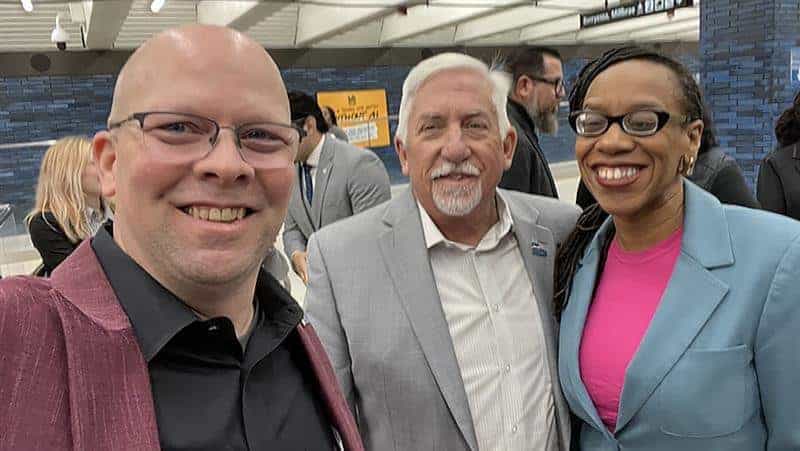
From left to right: SMART-TD Deputy National Safety & Legislative Director Don Roach, California State Safety & Legislative Director Louis Costa, and Congresswoman Simon

Proactive, Fact-Based Legislation Benefits Riders and Operators 

Roach praised Representative Simon for being proactive in protecting the safety of both operators and the riding public.  

“This legislation takes a smart, practical approach to improving safety on public transit—one that reflects the real experiences of riders and transit workers every day,” he explained. “By allowing federal safety grant dollars to fund transit support specialists, this bill emphasizes prevention, visibility and early intervention.”

SMART-TD calls on Congress to support and pass the RIDER Safety Act. Together with our transit brothers and sisters across the country, we will continue fighting until all operators are guaranteed the safest work environment possible!