On February 23, 2026, workers at SPX Cooling Technologies, LLC in Springfield, Missouri, voted to ratify their first contract as SMART members. The three-year agreement includes a $1,500 ratification bonus, wage increases of over 11%, the preservation of health and retiree benefits and just cause protection against unfair discipline.

The victory came from workers who were organized to stand together and utilize labor’s oldest and most powerful weapon: the strike! On two different instances in November 2025, SPX workers struck, first for one day to protest the company’s removal of low-rise chairs from the workplace, and then once more for two days to protest the company’s hostile and callous response.

“We went to the picket line. We had our signs out there. We let the company know that this is not acceptable to us,” said SPX employee and SMART Local 208 member Andrew Stracke.

“The majority of our shop is looking for union representation”

SPX Cooling Tech employees at the Springfield facility, which opened in 2024, manufacture cooling towers and air-cooled heat exchangers; cooling towers, in particular, are in high demand as investment increases in data centers. The components that SPX employees manufacture are vital for the continued boom in data center construction.

Workers started to talk about organizing in response to various issues in the shop. Stracke, a Local 208 negotiating committee member who has worked at SPX since 2024, alleged instances of favoritism, different wage rates for different people, inconsistent discipline policies and more.

“I was actually the one that placed the call to [a union] office up in St. Louis,” Stracke recalled. “And I felt like the first thing I told them was, ‘look, the majority of our shop is looking for union representation.’”

“Me and Andrew, we were just kind of talking with each other one day about, you know, the unfair working conditions that we were experiencing at the time at the shop. We were just kind of trying to figure out what we could do about it. It was just regular old employees,” added fellow SPX worker and negotiating committee member Wyatt King. “One employee by yourself, you know, you’re not going to have a lot of weight behind you, but when you organize into a union, you can actually address unfair working conditions and unfair wages.”

Members demand a change

The workers at SPX Cooling Technologies in Springfield overwhelmingly elected SMART Local 208 to represent them in a July 2025 National Labor Relations Board (NLRB) election.

But despite the workers’ strong support for the union, SPX initially opposed their organizing. The day after workers won their election, management took away the low-rise chairs that workers used on the job, forcing them to work on their knees.

“I was just astonished … everybody was just kind of like, ‘well, you know, it’s clear retaliation towards electing a union to represent us,’” said King. “I mean, some of those guys in the shop are 60 years old working on the concrete, on their knees all day.”

On Friday, November 7, workers engaged in a one-day grievance strike over the removal of chairs. The strike was covered by the Springfield News-Leader newspaper.

“Any concerns that we’ve raised, whether it’s about chairs, retaliation, harassment, intimidation — they’ve just stonewalled us on all of it. There’re no discussions,” SMART Central States Regional Production Council Organizer Richard Harris said in an article in the News-Leader. “We should be able to sit down and talk about these issues and resolve them. We shouldn’t have to resort to this.”

Workers attempted to serve their strike notice on an SPX supervisor. But the supervisor refused to meet with them. Instead, a woman workers identified as the supervisor’s wife pulled up to the picket line in a white sedan with two anti-union signs taped to her back windows. One read: “F**k the Union.” The other: “Do what lil b*tches do best while down on your knees!!!” She proceeded to drive back and forth in front of the picket line, shouting profanities at the workers and threatening to have them arrested.

The week after the strike, workers submitted a harassment complaint with SPX’s General Counsel in Charlotte, N.C., regarding the signs. The complaint was signed by nearly everybody in the shop. In the meantime, management continued to threaten workers for participating in the strike. One worker who took part in the strike was verbally reprimanded for “not walking with a purpose.” 

Unsatisfied with SPX’s handling of their harassment complaint, workers struck a second time on November 24 and 25. Picket signs read: “Walk with purpose! We strike today!”

Direct action gets the goods

Seasoned union leaders know how difficult first contract campaigns are. The legal consequences for bargaining in bad faith are next to nothing — a notice posting and promise not to do it again — so many employers adopt a strategy of endless delay. According to recent studies, 63% of first contracts fail to settle in one year, and 43% are still unresolved after two. The average time from NLRB certification to first contract — if one is ever reached — is 465 days!

How, then, did SPX workers manage to win their first contract in under six months? By recognizing the structural power they have within the data center economy, and by taking direct action to resolve their grievances. The strikes had an immediate effect on SPX’s demeanor at the bargaining table. Company representatives freely admitted the top priority was getting units assembled and out the door, which the strikes interfered with. Before the strikes, the company was agreeing to meet to bargain once every six weeks; after the strikes, the parties were meeting six days per month.

Collective strength and common ground

In the following months, Local 208 members say, the workers stood strong. And when they voted to ratify their first contract as SMART members, their agreement included a clause requiring the company to provide low-rise chairs.

“We’ve held so many meetings with the bargaining unit, and the participation has been outstanding,” said Stracke. “We have a really high percentage of people that work in the facility that are completely on board. They’re completely invested, they’re excited to see what working with this union and negotiating a contract, what could come of it. And already we have seen the union step up whenever they needed to step up, and give us answers when we need answers.”

In turn, the negotiating committee reports, the relationship between workers, Local 208 and management has started to improve.

“I think we’re in the middle of establishing a great line of communication and work relationships between the company, the employees and the union, and hopefully, this is a relationship that we’re able to keep going even beyond our first contract,” said Logan Hirst, SPX worker and Local 208 negotiating committee member.  

Other members of the negotiating committee are similarly optimistic about the road ahead — largely because, as SMART members, they’re not just individuals at work anymore. They’re part of something bigger.

“We’re not just bringing up our complaints to management, and they just do whatever they want with it. We actually have a voice, we have a lot of weight behind us now, and they actually have to listen to us,” said King. “They have to negotiate fairly. … We’re all standing together to make real change in our workplace.”

The SMART difference:
  • Workers at SPX Cooling Technologies, LLC in Springfield, Missouri, voted to ratify their first contract as SMART members in February.
  • The three-year agreement includes a $1,500 ratification bonus, wage increases of over 11%, the preservation of health and retiree benefits and just cause protection against unfair discipline.
  • On two different instances in November 2025, SPX workers struck, first for one day to protest the company’s removal of low-rise chairs from the workplace, and then once more for two days to protest the company’s hostile and callous response.
  • The average time from NLRB certification to first contract — if one is ever reached — is 465 days. SPX workers won their first contract in under six months.

There are many traits that make the union trades the gold standard in the construction industry. But the most defining characteristics are, without a doubt:

  1. the solidarity that defines the labor movement, and
  2. the top-notch training and skill that union workers bring to the workplace.

For SMART sheet metal workers, union solidarity and union craftsmanship go hand-in-hand. SMART Local 36 proved that with its work to rebuild the roof of the Missouri Historical Society Library and Research Center.

A historic disaster

In May 2025, St. Louis experienced its first deadly tornado since 1959.

For 27 minutes, the tornado tracked across more than 20 miles of Greater St. Louis, leaving devastation and destruction in its wake. Five people were killed, with an estimated $1.6 billion in property damage spanning 5,000 structures. One of those structures was the Missouri Historical Society Library and Research Center, particularly its exterior and distinctive domed copper roof.

The Library and Research Center features a large collection of Thomas Jefferson papers, one million photographs and prints, video and audio recordings, artifacts related to Lewis and Clark, and much more. Together, the copper dome and barreled roof were a symbol of the Center itself: historic, artful and beautiful.  

And when it came time to rebuild this St. Louis-area staple, Local 36 and signatory contractor David Hyde & Associates were ready to step to the plate.

SMART craftsmanship on display

SMART architectural sheet metal workers brought the commitment and expertise that defines our union to the restoration project.  

“David Hyde & Associates (DH&A) and union craftsmanship are on full display fabricating and installing this copper dome and barrel roof,” Local 36 wrote on Facebook back in November 2025.

Specifically, members meticulously placed 88 rows of gleaming copper panels onto the domed roof, bringing a historic building — whose origins date back to 1927 — back to life.

That’s the role we play in our communities!

On February 23, 2026, workers at SPX Cooling Technologies, LLC in Springfield, Missouri, voted to ratify their first contract as SMART members. The three-year agreement includes a $1,500 ratification bonus, wage increases of over 11%, the preservation of health and retiree benefits and just cause protection against unfair discipline.

The victory came from workers who were organized to stand together and utilize labor’s oldest and most powerful weapon: the strike! On two different instances in November 2025, SPX workers struck, first for one day to protest the company’s removal of low-rise chairs from the workplace, and then once more for two days to protest the company’s hostile and callous response.

“We went to the picket line. We had our signs out there. We let the company know that this is not acceptable to us,” said SPX employee and SMART Local 208 member Andrew Stracke.

“The majority of our shop is looking for union representation”

SPX Cooling Tech employees at the Springfield facility, which opened in 2024, manufacture cooling towers and air-cooled heat exchangers; cooling towers, in particular, are in high demand as investment increases in data centers. The components that SPX employees manufacture are vital for the continued boom in data center construction.

Workers started to talk about organizing in response to various issues in the shop. Stracke, a Local 208 negotiating committee member who has worked at SPX since 2024, alleged instances of favoritism, different wage rates for different people, inconsistent discipline policies and more.

“I was actually the one that placed the call to [a union] office up in St. Louis,” Stracke recalled. “And I felt like the first thing I told them was, ‘look, the majority of our shop is looking for union representation.’”

“Me and Andrew, we were just kind of talking with each other one day about, you know, the unfair working conditions that we were experiencing at the time at the shop. We were just kind of trying to figure out what we could do about it. It was just regular old employees,” added fellow SPX worker and negotiating committee member Wyatt King. “One employee by yourself, you know, you’re not going to have a lot of weight behind you, but when you organize into a union, you can actually address unfair working conditions and unfair wages.”

Members demand a change

The workers at SPX Cooling Technologies in Springfield overwhelmingly elected SMART Local 208 to represent them in a July 2025 National Labor Relations Board (NLRB) election.

But despite the workers’ strong support for the union, SPX initially opposed their organizing. The day after workers won their election, management took away the low-rise chairs that workers used on the job, forcing them to work on their knees.

“I was just astonished … everybody was just kind of like, ‘well, you know, it’s clear retaliation towards electing a union to represent us,’” said King. “I mean, some of those guys in the shop are 60 years old working on the concrete, on their knees all day.”

On Friday, November 7, workers engaged in a one-day grievance strike over the removal of chairs. The strike was covered by the Springfield News-Leader newspaper.

“Any concerns that we’ve raised, whether it’s about chairs, retaliation, harassment, intimidation — they’ve just stonewalled us on all of it. There’re no discussions,” SMART Central States Regional Production Council Organizer Richard Harris said in an article in the News-Leader. “We should be able to sit down and talk about these issues and resolve them. We shouldn’t have to resort to this.”

Workers attempted to serve their strike notice on an SPX supervisor. But the supervisor refused to meet with them. Instead, a woman workers identified as the supervisor’s wife pulled up to the picket line in a white sedan with two anti-union signs taped to her back windows. One read: “F**k the Union.” The other: “Do what lil b*tches do best while down on your knees!!!” She proceeded to drive back and forth in front of the picket line, shouting profanities at the workers and threatening to have them arrested.

The week after the strike, workers submitted a harassment complaint with SPX’s General Counsel in Charlotte, N.C., regarding the signs. The complaint was signed by nearly everybody in the shop. In the meantime, management continued to threaten workers for participating in the strike. One worker who took part in the strike was verbally reprimanded for “not walking with a purpose.” 

Unsatisfied with SPX’s handling of their harassment complaint, workers struck a second time on November 24 and 25. Picket signs read: “Walk with purpose! We strike today!”

Direct action gets the goods

Seasoned union leaders know how difficult first contract campaigns are. The legal consequences for bargaining in bad faith are next to nothing — a notice posting and promise not to do it again — so many employers adopt a strategy of endless delay. According to recent studies, 63% of first contracts fail to settle in one year, and 43% are still unresolved after two. The average time from NLRB certification to first contract — if one is ever reached — is 465 days!

How, then, did SPX workers manage to win their first contract in under six months? By recognizing the structural power they have within the data center economy, and by taking direct action to resolve their grievances. The strikes had an immediate effect on SPX’s demeanor at the bargaining table. Company representatives freely admitted the top priority was getting units assembled and out the door, which the strikes interfered with. Before the strikes, the company was agreeing to meet to bargain once every six weeks; after the strikes, the parties were meeting six days per month.

Collective strength and common ground

In the following months, Local 208 members say, the workers stood strong. And when they voted to ratify their first contract as SMART members, their agreement included a clause requiring the company to provide low-rise chairs.

“We’ve held so many meetings with the bargaining unit, and the participation has been outstanding,” said Stracke. “We have a really high percentage of people that work in the facility that are completely on board. They’re completely invested, they’re excited to see what working with this union and negotiating a contract, what could come of it. And already we have seen the union step up whenever they needed to step up, and give us answers when we need answers.”

In turn, the negotiating committee reports, the relationship between workers, Local 208 and management has started to improve.

“I think we’re in the middle of establishing a great line of communication and work relationships between the company, the employees and the union, and hopefully, this is a relationship that we’re able to keep going even beyond our first contract,” said Logan Hirst, SPX worker and Local 208 negotiating committee member.  

Other members of the negotiating committee are similarly optimistic about the road ahead — largely because, as SMART members, they’re not just individuals at work anymore. They’re part of something bigger.

“We’re not just bringing up our complaints to management, and they just do whatever they want with it. We actually have a voice, we have a lot of weight behind us now, and they actually have to listen to us,” said King. “They have to negotiate fairly. … We’re all standing together to make real change in our workplace.”

The SMART difference:
  • Workers at SPX Cooling Technologies, LLC in Springfield, Missouri, voted to ratify their first contract as SMART members in February.
  • The three-year agreement includes a $1,500 ratification bonus, wage increases of over 11%, the preservation of health and retiree benefits and just cause protection against unfair discipline.
  • On two different instances in November 2025, SPX workers struck, first for one day to protest the company’s removal of low-rise chairs from the workplace, and then once more for two days to protest the company’s hostile and callous response.
  • The average time from NLRB certification to first contract — if one is ever reached — is 465 days. SPX workers won their first contract in under six months.

The hotel booking deadline has been extended for the SMART Transportation Division’s Regional Training Seminar (RTS) to take place Nov. 14 through 17, 2022, at the Hilton Branson Convention Center in Branson, Mo.

Single- and double-occupancy rooms can now be booked at the event through Oct. 28.

Attending an RTS is an exciting opportunity for local leadership and members to engage one on one with union experts to help fulfill the need for local training closer to home.

The cost for TD members to register to attend the seminar is $50.

Registration for the event is open and available online via the SMART website.

The RTS includes classes on local governance, the roles of local legislative representatives and local chairpersons in protecting members and on the SMART Constitution.

The classes are taught by national officers and other subject matter experts associated with SMART-TD.

President Jeremy Ferguson also is scheduled to appear to answer membership questions.

To register for the seminar, visit https://register.smart-union.org/.

Please note: Attendees are responsible for making their own hotel reservations.

Room blocks have been reserved at both the Hilton Branson Convention Center and the Hilton Promenade at Branson Landing.

The SMART TD event rate is $189 per night (single/double occupancy), as mentioned, the deadline for hotel reservations is October 28 for the event rate.

This special rate is available for members beginning Nov. 14, which is the registration day for the RTS.

Classes will begin on the 15th and run through the 17th.

For more information, contact Gerald Sale at 870-761-0643 or by email at smartarslb@yahoo.com.

Go here for a printable flyer about the event.

A two-person crew bill has been introduced in the Missouri Legislature, and we’ll need the support of SMART members in the region to help get the legislation passed.
H.B. 2229 was introduced January 16 by state Rep. Jim Neely (District 8), a Republican who is also a medical doctor. The bill, a joint effort of SMART-TD and the Brotherhood of Locomotive Engineers and Trainmen, has had two readings by members of the House and now sits on the desk of Speaker Elijah Haahr awaiting a committee assignment so a hearing can take place.
“We need your help to pressure Speaker Haahr to assign H.B. 2229 to a committee and move it forward,” SMART-TD Missouri State Legislative Director Jason Hayden said. “Phone calls and emails into his office asking him to move this bill are what we need. Calls and emails to your representative to explain the two-person crew issue are also very important.”
Speaker Haahr’s office phone number is 573-751-2210. His email address is Elijah.Haahr@house.mo.gov.
Hayden wanted to give special credit to Stacey Garton, the wife of BNSF conductor Glen Garton of TD Local 259 in St. Joseph, Mo. Her efforts and the grassroots support given by fellow members of the Facebook page Fight for Two Person Crews helped her to approach Neely. She then connected Hayden and BLET State Legislative Chairman Calvin Groose with Neely so that the bill could be finalized before introduction.
“It was not hard for Rep. Neely to understand the grave situation it not only puts the single employee in but also the general public,” Hayden said about the dangers of one-person freight operations. “He was actually not on my radar as someone to approach about carrying the bill for us. But this situation goes to show allies can come from the most unexpected places. It really is all about how an issue touches someone.”
A great show of support from union members and their family and friends in Missouri in contacting their state legislators will help to show the Show Me State that H.B. 2229 matters for the continued safety of both rail workers and for the public.
Members wanting to assist in the effort to get the word out about this important legislation and to have their voices heard can contact Hayden at director@smartmoslb.org.
“We have the numbers to make this happen, we just need your help to accomplish it,” he said.

With the partial federal government shutdown in its 35th day on Jan. 25, many small- to mid-sized transit agencies are reporting a financial pinch, Politico.com reports.
Agencies in North Carolina, Missouri, Arizona and California all say that cuts in service are on the table if the shutdown persists.
And at least one transit provider, Cape Fear Public Transportation Agency in Wilmington, N.C., is considering a plan to not operate in February because of a lack of funds. Its executive director reports that Federal Transit Administration (FTA) reimbursements for the first four months of the fiscal year have not been processed with each reimbursement representing a quarter of its monthly operating budget.
But even if the shutdown ended soon, it would not guarantee that the payments would arrive to fund operations, executive director Albert Eby told Politico.com.
Read the full story at politico.com.

HOLLYWOOD, Fla. — The results of Tuesday’s elections, while not the absolute best-case scenario for labor, indicated that voters might be ready to end the one-party majority in the federal government in three months’ time, said SMART Transportation Division National Legislative Director John Risch at the opening session of the last day of the 2018 Regional Meeting at the Hilton Diplomat Resort.
A special election campaign in Ohio saw both President Donald Trump and Vice President Mike Pence appear in support of Troy Balderson, who was running to finish out the remaining months of a term in Ohio’s 12th Congressional District. The seat was left vacated by fellow-Republican Pat Tiberia.
Yet even with the top two Republicans in the nation trying to give Balderson some momentum, he defeated Danny O’Connor, a relatively unknown Democrat, by 1 percent, according to unofficial results Tuesday. The 12th District, which includes Ohio’s capital Columbus, was carried by Trump by more than 11 points in the 2016 presidential election, according to The Associated Press.
Balderson and O’Connor will square off again in November for a full term to represent the district in Congress, and the result could be different with such a narrow margin.
Missouri’s special election Tuesday brought better news for labor, in what has been “a solidly red” state, Risch said.
Proposition A, a labor-led referral effort to repeal right-to-work legislation, was successful with 67 percent of voters voting to repeal a right-to-work law in place. Thirty-three percent of voters voted to keep the law, according to unofficial results. Labor faced much opposition with the Koch brothers leading an underground deceptive ‘yes vote’ effort that would have kept the right-to-work law in place. Missouri would’ve been the 28th state with such legislation in place had the referral not been successful.
“Even with all the deceptiveness, even with all the ways in which they tried to tilt the playing field in their favor – all of that, we won in Missouri,” Risch said.
He said a majority of voters in Missouri understood and recognized that Proposition A’s backers were trying to undermine the ability of unions to get better wages, fringe benefits and improve safety through deceptive direct mailings and other tactics.
“When they understand this, they vote the right way,” Risch said. “They vote for themselves, they vote for their unions, they vote for the ability to do something in the workplace.”
Risch feels that this victory, as well as victories by teachers in West Virginia, Arizona and Colorado this year, could signal a turning point for workers in the fight against income inequality.
“I see a trend, I see a movement across this country,” he said. “I think the tide is turning. I hope the tide is turning because we can’t go the other direction much longer.”

SMART Transportation Division National Legislative Director John Risch addresses attendees Wednesday at the opening session of the final day of the Hollywood, Fla., Regional Meeting.
SMART Transportation Division National Legislative Director John Risch addresses attendees Wednesday, Aug. 8 at the opening session of the final day of the Hollywood, Fla., Regional Meeting.

Members in Missouri & New Hampshire: Call your State House Representatives!

The state of Missouri recently passed a right-to-work (for less) bill in the State Senate, 21-12. A similar bill is expected to pass in the state’s House as well. If the bill passes in the State House, Mo. Governor Eric Greitens (R) has pledged to sign the bill into law.
If you live in Missouri, now is the time to contact your legislators and tell them that you don’t want Missouri to become a right-to-work (for less) state. Click here to find your Representative and their contact information.
In a much closer vote, the New Hampshire State Senate voted 12-11 to pass right-to-work (for less). The bill now heads to the Republican-controlled House for a vote. N.H. Governor Chris Sununu (R) has indicated that he will sign the bill into law if it passes in the State House.
Members from New Hampshire: click here to find your Representatives and their contact information.
According to the AFL-CIO, states that have enacted these so-called right-to-work laws have lower wages and incomes (about $6,000 less per year); little or no health insurance coverage and pay higher premiums; higher poverty rates; higher workplace fatality rates by 49 percent; and lower investments in education. These laws not only hurt unions, but the members who depend on the union as well.
Call your legislators today and tell them that you don’t want right-to-work (for less) in your state!

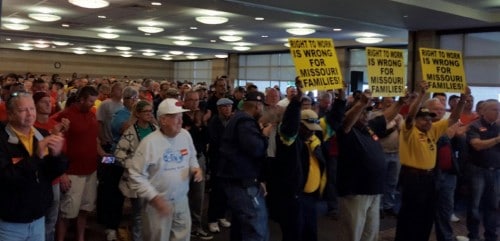
Missouri Right To Work VetoMissouri State Legislative Director Ken Menges asks Missouri SMART members to join in the fight against right-to-work. Although Governor Jay Nixon vetoed the right-to-work legislation June 4 at the SMART Sheet Metal Local 36 facility, a battle has been raging in the state to get that veto overturned.

A veto session is scheduled for Wednesday, September 16, 2015 to revisit the right-to-work legislation and to overturn the veto.

“We have worked hard since the legislative session ended in May to visit and show support for both our Democrat and Republican friends,” Menges said. “I would like to extend a special thanks to Assistant State Director Jason Hayden (Local 1405 – St. Louis), Local Legislative Representatives Thad Krawczyk (Local 933 – Jefferson City, Mo.), Josh Stallings (Local 1823 – St. Louis), Gerald Wohlgemuth (Local 226 – Moberly, Mo.) and Dan Coleman (Local 1780 – Kansas City, Mo.) for spending several days canvassing door-to-door, working to get letters from union members to their legislators and thanking them for their support.

“According to the Missouri AFL-CIO we have had nearly 20,000 letters and calls go out to legislators, which is phenomenal.”

A rally was held September 12 in preparation for the fight against Governor Nixon’s veto being overturned. The rally was attended by hundreds of union members across the state, including SMART membership. Governor Jay Nixon was a keynote speaker at the event.

Mo rally_Nixon
Missouri Governor Jay Nixon addresses attendees at an anti-right-to-work rally
Sept. 12 rally against overturning right-to-work veto is attended by hundreds of union members.

Missouri Right To Work VetoJEFFERSON CITY, Mo. — A major Republican donor, David Humphreys, who had been relatively quiet donated half a million dollars to a new committee Sept. 15 that is rumored to be targeting Republicans that support Gov. Jay Nixon’s veto of Right-to-Work legislation.
Days ago, the “Committee for Accountable Government in Missouri” filed with the Missouri Ethics Commission and Humphreys, President and CEO of Joplin-based Tamko Building Products and a longtime generous Republican donor, dropped $500K into the committee.
Read more from The Missouri Times.