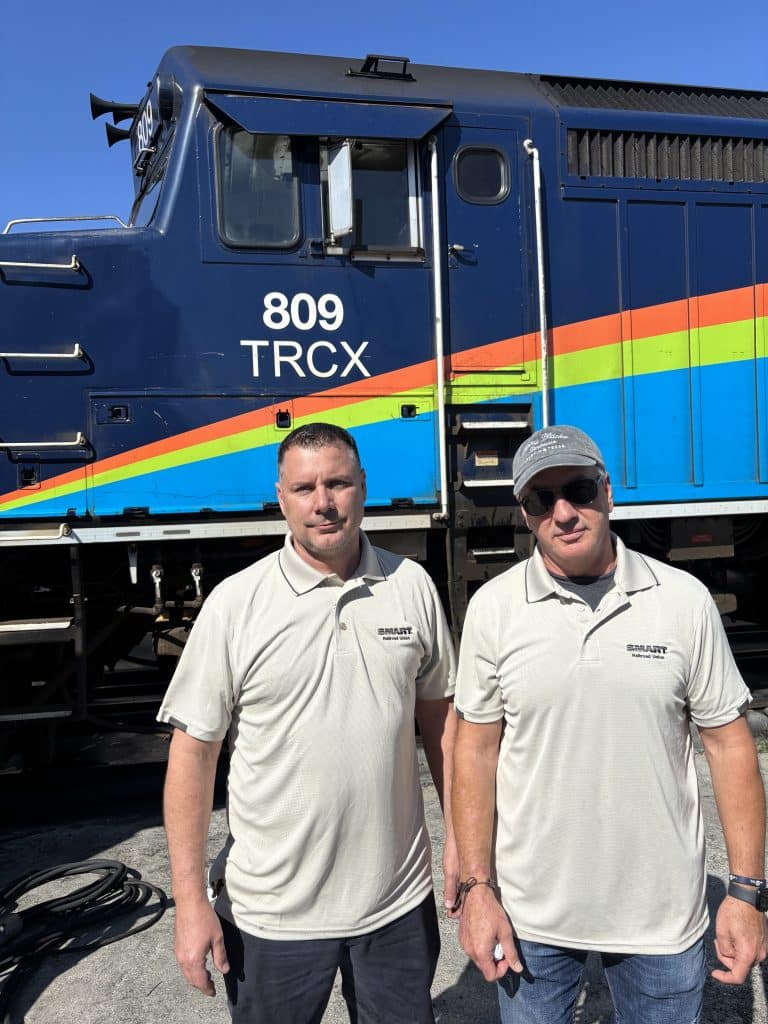
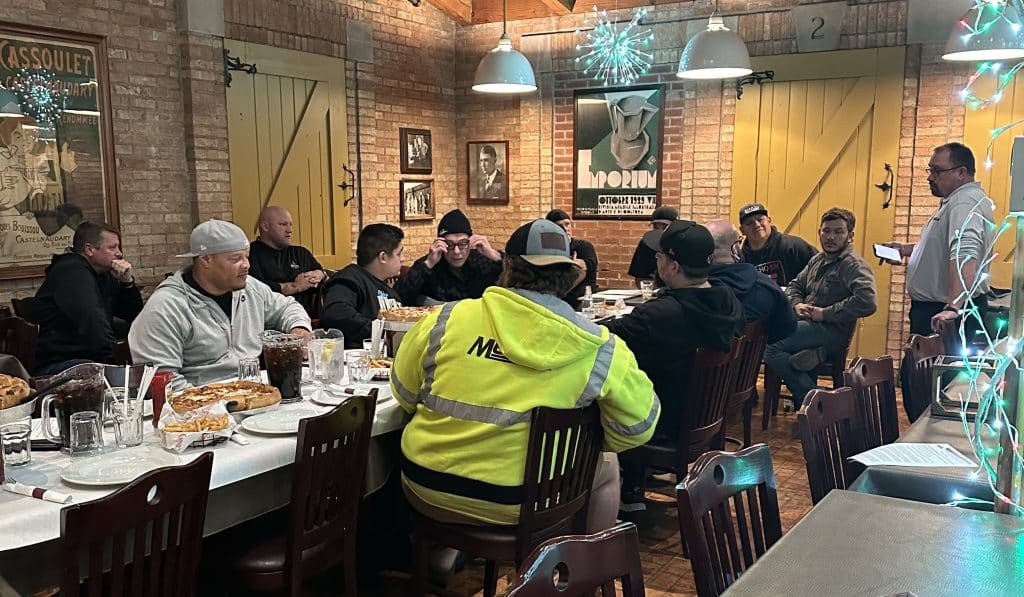
SMART Local 398 members from San Diego Metropolitan Transit System (MTS) and North County Transit District (NCTD) came together in February and April 2026 for two impactful rounds of training designed to educate, empower and build stronger connections within their workplace and across San Diego County transit employers.

Local 398 members on NCTD operate commuter trains, dispatch trains, perform security work to ensure passengers can take public transit safely, and clean and maintain NCTD train stations and facilities. Members on MTS perform light rail vehicle overhauls and repairs, inspect and repair catenary lines, track maintenance, cleaning and maintenance of MTS train stations and facilities, operation of light rail vehicles, clerical work, warehouse material handling and logistics, as well as maintenance and repair of transit fare machines.

Workers at both transit systems operate across San Diego County but rarely — if ever — interact. With these training sessions, SMART brought members a valuable opportunity to exchange ideas, compare best practices and build a unified approach to common workplace issues. Participants engaged in hands-on learning, open discussions and strategy sessions aimed at strengthening both individual capability and collective voice.

“If we want stronger membership, we need stronger connections. This training is helping build those needed connections,” said Local 398 MTS Maintenance of Way Department worker Rene Fuentevilla. 

Local 398 MTS Light Rail Vehicle Department worker Scott Wildhaber agreed.

“The training sessions reminded me that no matter where we come from or what department or transit agency we work for, a lot of us are dealing with the same workplace issues and want the same things: respect, fairness and a voice on the job,” he said.

The first session, held on February 26, laid the groundwork by focusing on core knowledge, shared challenges and the importance of collaboration. A second, more advanced training followed on April 30, reinforcing those lessons with hands-on learning while deepening relationships among the participants. Both sessions were held at SMART Local 206’s McClees Hall.

Beyond the technical and professional development, the training confirmed that many of the challenges facing transit workers are not isolated, but shared across agencies, regions and operating models.

Notably, the training was developed and led by representatives from two distinct departments —the SMART Railroad, Mechanical and Engineering (RME) and the Production Workers Departments — each with different day-to-day functions but facing many of the same workplace challenges. By working together to design and deliver the program, these departments demonstrated how diverse roles within SMART can align around the shared goals of solidarity, bringing respect to and empowering workers. The collaboration not only strengthened the content of the training, but also intentionally exposed participants to the breadth of skills, perspectives and experiences across SMART — underscoring both the diversity and solidarity that define their union.

“Much thanks goes to SMART’s Director of Production Workers Dave Goodspeed and International Organizers Laura Nunez and Julian Posadas for their leadership and collaboration in building and delivering this training,” said SMART RME Department Director Peter Kennedy. “Your commitment made it possible to bring MTS and NCTD workers together, strengthen our knowledge, and move forward with a stronger shared purpose. We also want to thank Dave Gauthier and Local 206 for their unwavering support of the members of SMART Local 398, as they make our training possible with their facilities.”

In so-called “right-to-work” states like Florida — the home of commuter rail service Tri-Rail — union workers are often forced to overcome multiple obstacles during contract negotiations. On the one hand, they’re trying to make gains on pay, benefits and working conditions. On the other, they need to surmount potential division between the workers who have signed up for the union and those who opt out of representation.  

But that wasn’t a problem at Tri-Rail’s Hialeah, Florida, facility during the most recent round of contract negotiations. The tireless work of SMART Mechanical Department Local Chairpersons Luis Roves and Raul Barnat ensured every single worker on the property signed up to be a member of SMART-MD — and when the time came to vote on a new contract, every single SMART-MD member cast a vote. The result: 100% ratification.

“Everyone was on the same page,” said SMART-MD General Committee 2 Directing General Chairperson John McCloskey, who negotiated the agreement alongside International Rep. Rob Shanahan. “We had one unified message, and that made it easy to negotiate as one voice and win the contract the members wanted.”

SMART-MD first organized and negotiated a contract at the Hialeah facility in 2015. At the time, 15 of the 28 Tri-Rail employees signed up for union representation.

When ownership of Tri-Rail changed hands from Bombardier to Herzog Transit Services in 2019, SMART-MD ran another organizing campaign at the facility, with Roves and Barnet playing key roles. The two local chairpersons engaged every employee, including brand-new hires — explaining the union advantage and the importance of signing up with SMART-MD. Eventually, they established 100% union membership throughout the property.

“There is definitely a language barrier when I’m down in Miami,” said McCloskey, an Irish immigrant. An added difficulty for McCloskey and Shanahan: The vast majority of the Tri-Rail employees are of Cuban descent, mostly speaking English as a second language. “Luis and Raul are just so proactive. They kept it together in a right-to-work state. They fielded all the questions, all the concerns.”

The previous Tri-Rail contract was subject to renegotiation on July 1, 2024, with SMART-MD initiating discussions two months prior. With Roves and Barnat consistently in contact with Tri-Rail’s workforce, relaying their priorities to McCloskey and Shanahan, SMART-MD eventually reached a tentative agreement with the employer in February, with the unanimous, full-participation ratification vote taking place shortly after.

McCloskey paid tribute to Roves and Barnet’s industrious work on behalf of their fellow Tri-Rail employees, calling their effort a “great success.” He also noted how the negotiation process demonstrated our union’s values.

“At the end of the day, we serve our members no matter their background — we’re not going to let a language barrier get in the way,” he said. “That isn’t going to deter anyone in our organization from negotiating a good contract.”

In so-called “right-to-work” states like Florida — the home of commuter rail service Tri-Rail — union workers are often forced to overcome multiple obstacles during contract negotiations. On the one hand, they’re trying to make gains on pay, benefits and working conditions. On the other, they need to surmount potential division between the workers who have signed up for the union and those who opt out of representation.  

But that wasn’t a problem at Tri-Rail’s Hialeah, Florida, facility during the most recent round of contract negotiations. The tireless work of SMART Mechanical Department Local Chairpersons Luis Roves and Raul Barnat ensured every single worker on the property signed up to be a member of SMART-MD — and when the time came to vote on a new contract, every single SMART-MD member cast a vote. The result: 100% ratification.

“Everyone was on the same page,” said SMART-MD General Committee 2 Directing General Chairperson John McCloskey, who negotiated the agreement alongside International Rep. Rob Shanahan. “We had one unified message, and that made it easy to negotiate as one voice and win the contract the members wanted.”

SMART-MD first organized and negotiated a contract at the Hialeah facility in 2015. At the time, 15 of the 28 Tri-Rail employees signed up for union representation.

When ownership of Tri-Rail changed hands from Bombardier to Herzog Transit Services in 2019, SMART-MD ran another organizing campaign at the facility, with Roves and Barnet playing key roles. The two local chairpersons engaged every employee, including brand-new hires — explaining the union advantage and the importance of signing up with SMART-MD. Eventually, they established 100% union membership throughout the property.

“There is definitely a language barrier when I’m down in Miami,” said McCloskey, an Irish immigrant. An added difficulty for McCloskey and Shanahan: The vast majority of the Tri-Rail employees are of Cuban descent, mostly speaking English as a second language. “Luis and Raul are just so proactive. They kept it together in a right-to-work state. They fielded all the questions, all the concerns.”

The previous Tri-Rail contract was subject to renegotiation on July 1, 2024, with SMART-MD initiating discussions two months prior. With Roves and Barnat consistently in contact with Tri-Rail’s workforce, relaying their priorities to McCloskey and Shanahan, SMART-MD eventually reached a tentative agreement with the employer in February, with the unanimous, full-participation ratification vote taking place shortly after.

McCloskey paid tribute to Roves and Barnet’s industrious work on behalf of their fellow Tri-Rail employees, calling their effort a “great success.” He also noted how the negotiation process demonstrated our union’s values.

“At the end of the day, we serve our members no matter their background — we’re not going to let a language barrier get in the way,” he said. “That isn’t going to deter anyone in our organization from negotiating a good contract.”

On January 13, 2025, SMART Railroad, Mechanical and Engineering Department (SMART-MD) members ratified the national agreement with the National Carriers’ Conference Committee (NCCC)-represented railroads. 

The five-year agreement is virtually identical to other freight rail agreements and provides:

  • Annual general wage increases effective July 1 of each calendar year, totaling 17.5% (over 18.75% when compounded);
  • Paid vacation days for new-hire employees;
  • Accelerated qualification and accrual of paid vacation for tenured employees;
  • Various improvements to health and welfare benefits, including the extension of health and welfare coverage for surviving dependents, male sterilization procedures (i.e., vasectomy), as well as substantial increases for vision frame allowances (from $115 to $250 every two years) and an orthodontia lifetime maximum benefit increase from $1,000 to $2,500 per covered individual;
  • An optional high-deductible health plan with lower monthly cost-share contribution that will be available in 2026;
  • Increased opt out payment of $200 per month for employees who select not to have health insurance. 

“The ratification of this agreement demonstrates SMART-MD’s commitment to negotiating for the improvements members have said they need: better pay and benefits, flexibility and increased quality of life,” said SMART General President Michael Coleman. “Almost as important is the fact that these negotiations were conducted in a timely, good-faith manner. I want to thank SMART-MD negotiators for their leadership and SMART-MD members for their engagement in this process.”

“I am glad the members ratified the national agreement,” SMART General Committee 2 Directing General Chairperson John McCloskey added. “It is one of the best negotiated agreements in my career and will provide meaningful improvements to the members, in record time. We hope that future rounds of national negotiations proceed more sensibly and result in fairer agreements such as this.”

CPKC, Union Pacific Railroad and Alton Southern did not participate in national negotiations this round and remain the only other freight rail properties that have not reached tentative agreements with SMART-MD.

SMART Rail, Mechanical and Engineering (RME) members employed by San Diego Trolley Inc. (SDTI) in San Diego, Calif., and North County Transit District (NCTD) in Oceanside, Calif., have elected a new slate of officers to guide Local 398 into the future.

Local 398 is responsible for the representation and enforcement of collective bargaining agreements for the majority of the public service employees within the SMART RME Department.

“There is an ongoing internal organizing campaign on both employers, and we have seen an increase in local union membership over the past 12 months. We look to build on that momentum, grow our local union membership and fight for the rights of our sisters and brothers,” said Financial Secretary-Treasurer Travis Malmin.

When Local 398 was relocated to San Diego, the members needed a place to come together. In a strong show of solidarity, SMART SM Local 206 opened the doors of McClees Hall to our brothers and sisters and provided space for members to gather for union meetings.

“Local 206 and Business Manager Dave Gauthier were gracious enough to allow us space to hold our membership meetings,” said Troy Teague, Local 398 vice president. “It is good to know that our union has resources that allow our members to meet and discuss their issues and concerns.”

Pictured, left to right: Travis Malmin (recording secretary/financial secretary-treasurer), Raymond (Joey) Flores (trustee), Troy Teague (vice president/ warden/conductor), Brandon Watson (president/local chairperson), Chache Rolison (trustee), Raymond Probst (trustee), Gabriel Puente (trustee). Not pictured: Juan Arias (trustee).

SMART and Local 398 are currently in contract negotiations with SDTI, aiming to secure a new agreement by the year’s end. Local union officers are engaging with each department in order to finalize additional proposals prior to the next bargaining session.

“I feel honored to be elected as the president and local chairperson of Local 398, and I look forward to obtaining the best possible outcome for my coworkers at SDTI,” said Brandon Watson.

October 4, 2024: The SMART Transportation Division proudly congratulates SMART Railroad, Mechanical and Engineering Division (MD) members for their achievement in ratifying collective bargaining agreements (CBAs) with three major rail carriers: BNSF, CSXT and Norfolk Southern.  

The newly ratified agreements will provide SMART-MD members with healthcare stability and annual wage increases through December 31, 2029. The five-year agreements guarantee an average general wage increase of 3.5% per year and include improvements in paid vacation and health and welfare benefits, maintaining a consistent employee monthly cost-share contribution. 

John McCloskey, General Committee 2 directing general chairperson, remarked on the significance of these agreements, stating, “GWIs of 18.8% compounded are almost unheard of in the freight industry, especially on a voluntary basis without concessions. I appreciate BNSF, CSX and NS negotiating with SMART-MD in good faith.” 

SMART-TD President Jeremy Ferguson told SMART News, “This is a milestone that underscores the strength and determination of SMART members in securing fair labor agreements. Congratulations to our brothers and sisters in the Mechanical Division!” 

In a strong show of unity, members voted in favor of the CBAs, with results reflecting significant support: 69% for BNSF, 68% for CSXT, and 62% for Norfolk Southern. This outcome highlights the commitment of SMART-MD’s members to engage in the ratification process and ensure their voices are heard. 

SMART-MD Director Peter Kennedy expressed gratitude to the members who participated, stating, “Thank you to the members that took the time to educate themselves about their agreement, and that participated in the ratification process. We are glad to have resolved negotiations with these major freight railroads. The remaining rail carriers need to follow the pattern that has been established by BNSF, CSXT and NS.” 

SMART General President Michael Coleman also praised the outcome, noting, “The members have passed their verdict on the agreements with BNSF, CSX-T and NS, with more than 60% voting in favor for each carrier. I am grateful for the determination and advocacy of the SMART-MD negotiating team, and I appreciate the leadership at BNSF, CSX-T and NS for resolving the next round of national negotiations without dragging out the bargaining process for years.” 

As we celebrate this victory, the SMART Transportation Division reaffirms its dedication to supporting all SMART divisions in their pursuit of equitable labor agreements. These successful ratifications serve as a powerful reminder that together, we can achieve meaningful progress and secure a better future for all rail industry workers. 

The International Association of Sheet Metal, Air, Rail and Transportation (SMART) Railroad, Mechanical and Engineering Department (MD) members employed on BNSF, CSX-T and Norfolk Southern Railway have voted to ratify their respective collective bargaining agreements (CBAs). Members voted in favor of the CBAs by 69% (BNSF), 68% (CSX) and 62% (NS).

With these agreements ratified, SMART-MD members employed by BNSF, CSX-T and NS have secured healthcare stability and annual wage increases through December 31, 2029.  

The CBAs on each respective rail carrier are essentially identical, consisting of a five-year term that provides for annual general wage increases (GWI) that average out to 3.5% per year, improvements for paid vacation, as well as improvements to health and welfare benefits without changing the employee monthly cost-share contribution of 15% of the carriers’ monthly payment rate. The CBAs also resulted in the creation of new benefit design for employees that desire to have employee-only coverage under a high deductible health plan at a reduced employee monthly cost-share contribution. 

“GWIs of 18.8% compounded are almost unheard of in the freight industry, especially on a voluntary basis without concessions,” said General Committee 2 Directing General Chairperson John McCloskey. “I appreciate BNSF, CSX and NS negotiating with SMART-MD in good faith and allowing us the opportunity to engage with the members throughout the ratification process.” 

“Thank you to the members that took the time to educate themselves about their agreement, and that participated in the ratification process. We are glad to have resolved negotiations with these major freight railroads. The remaining rail carriers need to follow the pattern that has been established by BNSF, CSX-T and NS,” added SMART-MD Director Peter Kennedy.

“The members have passed their verdict on the agreements with BNSF, CSX-T and NS, with more than 60% voting in favor for each carrier,” said SMART General President Michael Coleman. “I am grateful for the determination and advocacy of the SMART-MD negotiating team, and I appreciate the leadership at BNSF, CSX-T and NS for resolving the next round of national negotiations without dragging out the bargaining process for years. I am glad these railroads recognized that our members deserve to be compensated fairly with wage increases coming to them in real time, rather than years after the fact.” 

SMART Rail, Mechanical and Engineering (RME) members working for Norfolk Southern, BNSF and CSX will soon receive ratification information ballots from the American Arbitration Association regarding tentative agreements reached with the respective carriers on August 22.

The ratification vote will run from Monday, September 9, through Thursday, October 3; members will have until 11:59pm on Thursday, October 3 to cast their vote for their respective tentative agreement. The votes will be counted and announced on Friday, October 4. Please take the time to read through the relevant ratification information carefully. If members have questions, they should not hesitate to contact their SMART representatives.

The SMART Railroad, Mechanical and Engineering Department (SMART-MD) has reached tentative agreements with CSX, Norfolk Southern and BNSF Railway that will be sent to the membership for a vote in the days ahead. 

Section 6 notices for national negotiations are not allowed to be served until November 1, 2024; however, these tentative agreements were reached on an individual carrier basis, rather than under the national umbrella. The tentative agreements, if ratified, would resolve the next round of national negotiations for SMART-MD and each respective rail carrier.

Each five-year tentative agreement provides for annual general wage increases — effective July 1st of each calendar year — totaling 17.5% (over 18.75% when compounded), as well as paid vacation days for new-hire employees and the accelerated qualification and accrual of paid vacation for tenured employees. There are also improvements to health and welfare benefits, including the extension of health and welfare coverage for surviving dependents, male sterilization procedures (i.e., vasectomy), as well as substantial increases for vision frame allowances from $115 to $250 every two years. In addition, the orthodontia lifetime maximum benefit would increase from $1,000 to $2,500 per covered individual. 

The tentative agreements provide for a new individual employee-only health insurance benefits coverage that is not mandatory and will only apply to employees that select such coverage. Employees that select this new benefit will have a reduced monthly cost-share payment, capped at 10% of the carrier’s monthly payment rate. Employees that do not select the new individual employee-only health insurance benefit will continue to have their traditional employer-provided health insurance benefits, as well as a monthly cost-share payment of 15% of the carrier’s monthly payment rate. Employees that entirely opt out of their employer-provided coverage will now receive $200 per month instead of $100.  

“These tentative agreements provide real wage increases and substantial improvements to paid time off that the railroads have historically fought us on, as well as improvements to health and welfare benefits with an added benefit option for those that want it,” said SMART Directing General Chairperson John McCloskey. “These tentative agreements, if ratified, take away the uncertainty of when the next round of national negotiations will be completed, and if and when annual pay increases will be implemented.”

 “It is now up to the members to decide whether these agreements meet their standards,” added SMART General President Michael Coleman. “I know that all of SMART-MD, officers and staff, will be engaging with the members on each railroad property, answering questions and providing them with ratification material so they can make an informed decision.”

From local union visits to new member organizing, the SMART RME Department is actively working to strengthen and grow our union. Read updates on the department’s recent activities:

SMART RME International representatives visit local unions

SMART RME International Representative Joe Fraley and RME Department Director Peter Kennedy have been engaging with RME members at union meetings, visiting Locals 78 (Little Rock, Ark.), 165 (Argentine, Kan.), 256 (Chicago, Ill.), 462 (Huntington, W.Va.) and 472 (Topeka, Kan.) To provide information about local representative training, member engagement and other resources that are available for officers and members.

“Keep an eye out for meeting notifications in the future — we will be visiting remaining locals in 2024,” said Kennedy.

RME Department conducts trainings for local union officers

In November 2023, General Committee 2 officers, with assistance from International representatives, provided training to local union chairpersons for claim and grievance handling, as well as the representation of members at disciplinary hearings. The training, held in Chicago, marked the second of its kind for local chairpersons. The department also held its first training for newly elected recording secretaries and financial secretary-treasurers in Washington, DC.

“These training courses are offered at no cost to the local unions, as costs associated with the training are covered by General Committee 2 and the International,” explained Fraley. “These sessions will continue In 2024, again at no cost to local unions. Each local is encouraged to send their elected officers to these courses.”

SMART RME wins National Mediation Board election for RailTerm employees

On November 16, 2023, the RME Department won a representation election for employees working at RailTerm. This marks another organizing victory for SMART as we work to bring new members into our union.

“Negotiations will begin in the near future,” said Fraley. “We are proud to represent the RailTerm employees and are ready to negotiate an agreement with the company.”