SASMI trustees recently approved a 50% match on employer contributions to active members’ Health Reimbursement Accounts (HRAs).* The match begins with 2025 allocations that members received in their HRA balances early April 2026.
Looking ahead, SASMI trustees will review the Fund’s financial health each year and may approve further enhancements if the Fund’s financial position supports it.
What’s the active HRA?
The SASMI HRA is a special account funded with employer contributions — now with a 50% SASMI match — that active members can use to pay for eligible health care expenses such as:
Medications (prescription copays and hundreds of over-the-counter items like pain relievers)
Dental exams and cleanings
Vision exams
Hearing exams and hearing aids
Active members* can use a SASMI HRA debit card to pay for eligible out-of-pocket expenses or get reimbursed through the SASMI/HCRA app. Either way, it’s a convenient way to cover (or be reimbursed for) certain health care expenses that members would typically pay out of their own pockets.
No matter how you spend it, the HRA and the new 50% match represent a valuable opportunity to strengthen a member’s financial wellness.
How the SASMI HRA match works
Right now, the HRA employer contribution is 20% of the previous year’s employer contributions.
Beginning in 2026, active members will receive the employer’s contribution and SASMI will add an additional 50 cents for every dollar their employer contributes to the HRA on their behalf.
So, a member who got $800 in employer contributions would get an additional $400 in SASMI matching contributions, bringing the total HRA allocation for the member to $1,200 for 2026.
What this means for members
Take full advantage of your growing HRA balance! Your HRA is a non-deduct benefit, which means that it doesn’t affect your benefit amount at retirement. In fact, if you do not use your HRA dollars, they will roll into your HCRA at retirement.
The trades have a reputation for “running in the family.” Historically, a young man often followed in his father’s and even grandfather’s footsteps into a union. These days, not only is it increasingly common for women to find careers in the unionized trades, but in some cases the generational order of apprenticeship is switched around.
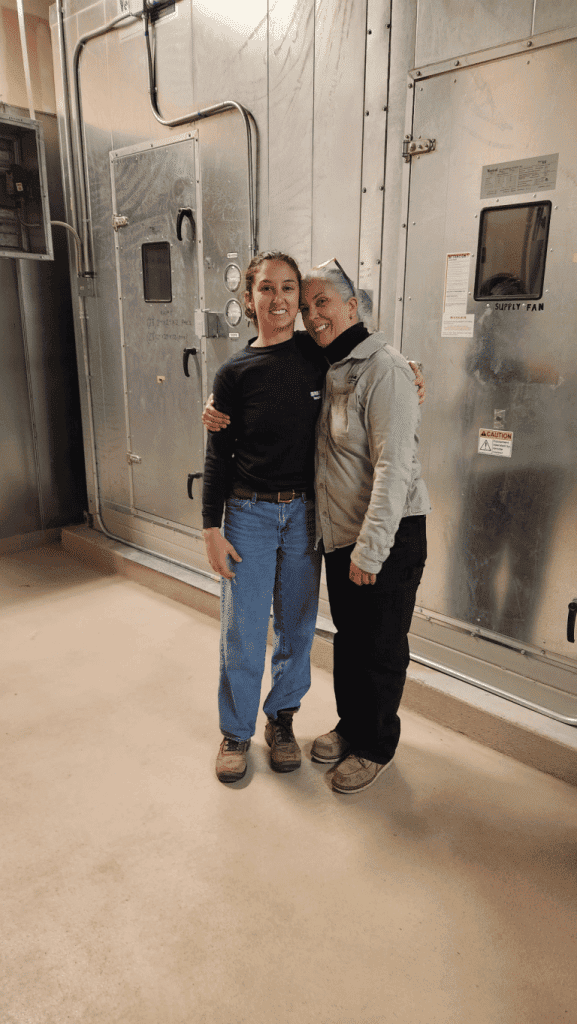
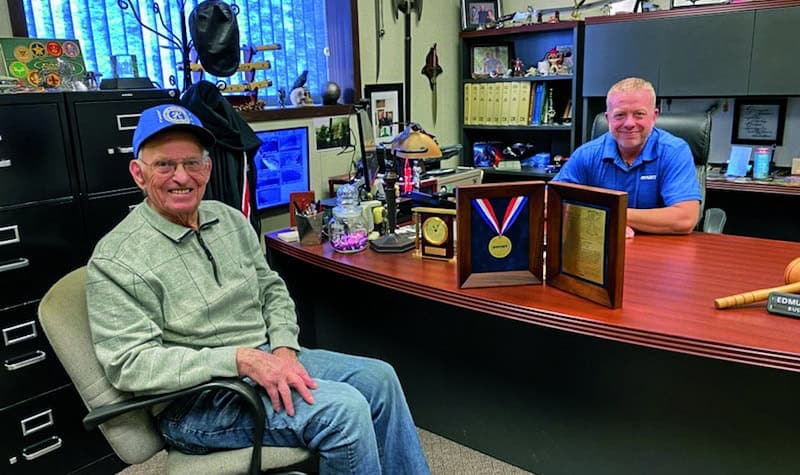
That’s the case for Sophia Thompson, 25, and her mother, Monica Thompson, 53, both in their third year of apprenticeship at SMART Local 49 in Albuquerque, New Mexico. Around the same time that the Thompsons started, Josh Edgington, 46, joined the apprenticeship at SMART Local 206 in San Diego after encouraging his son, Josh Edgington Jr., to join the union. Both are in their third year of apprenticeship as well.
Junior and JoshSophia and Monica
For Sophia and Monica Thompson, their journey began at a job fair at the Rio Rancho Events Center in 2022. Within five minutes, the two women had what Sophia called a life-changing experience: A representative from SMACNA showed them how to apply for an apprenticeship. That was on a Friday, and by Monday, Sophia was working in the apprenticeship. On Tuesday, her mother joined her. Both are the first in their family to enter the trades, and they agree it feels like the start of a great career.
Monica Thompson spent time as an aircraft mechanic in the Army, then later went to school to become an aesthetician — a completely different occupation but still working with her hands. After moving to the Albuquerque area, she found there were not that many positions in cosmetology.
“I did not want to do retail again,” Monica said. “The union was a really good alternative fit.”
Sophia entered college first and changed her major four times before earning an associate degree at Ivy Tech Community College in Indianapolis. Her plan was to find a job and save money to go back to school.
“I now see myself in the union for the long term,” she said. “This is a career opportunity for sure.”
Both are currently working for Energy Balance and Integration, based in Albuquerque. When they get to work together, they say their styles complement each other: Monica, with more life experience, is less afraid of trying new ways of doing things, while her daughter can be a bit more regimented.
“We know how each other works, and we work well together,” Monica said. “There’s no communication barriers, none.”
Both mother and daughter have gravitated toward testing, adjusting and balancing (TAB), a specialty that requires a strong command of math to fine-tune the performance of HVAC systems. After apprenticeship, Sophia plans to finish a degree in engineering as well. She said more people her age should be made aware of the tuition-free training SMART offers, and recalled a recent conversation with two welding students at the community college her sister attends.
“I told them about the union program, and they were baffled,” she said. “I explained it, but I don’t think they even believed me.”
In September 2025, the mother-daughter duo attended Tradeswomen Build Nations in Chicago, joining fellow SMART sisters at the largest gathering of unionized tradeswomen in the world.
Meanwhile, in San Diego, it was the elder Josh Edgington who urged his son, who goes by Junior, to join the union. Both had some college credits in HVAC and were working together in construction, but they noticed the pay was stagnant, and there were no benefits.
“I told him, ‘Go make something of your life, join a union, get into HVAC, it’s a good trade with a lot of opportunity,’” recalled Josh Edgington. “Then, to be honest, I joined because he joined. I started thinking, ‘Who am I to tell him to go and do this and I’m not going to do it?’”
Josh said he keeps his “dad hat” on all the time, and his parental instinct was in full gear as he showed Junior how to safely navigate the jobsite. Now, in their third year of apprenticeship, the father and son function more like a collaborative team.
“I got my feet wet in the shop and then got to jump in with my dad,” the younger Edgington said. “It’s just cool to work with him and actually know what I’m doing.”
When asked if his son has taught him anything, the father laughed and said, “patience!”
“I’ve taught him a bunch of stuff, yeah. Like, that he’s not always right — there’s different ways to do stuff,” Junior added.
The contractor they work for specializes in high-rises, which take up to two years to complete. With many high-rises going up in San Diego, both feel like they will enjoy a stable, rewarding career. Josh will finish apprenticeship first, thanks to earning some meritorious advancement in the program. He aims to become a foreperson, while his son is looking forward to getting more experience and becoming a well-rounded journeyperson. Josh said he’s proud to be union now, but even more proud that he got his son in, and on the right path, at an early age.
“I’ve taught him most of his life, it’s time for him to veer off and learn from better teachers now,” he said.
On Wednesday, February 4, Local 218 (Springfield, Ill.) member Renato Favero passed away at the age of 102 years old. In a fitting tribute to his long life as a World War II veteran, sheet metal worker and family man, he was surrounded by loved ones.
A lifetime of service
When Brother Favero was a little over 18 years old, he answered a call.
It was the early 1940s, and along with millions of fellow Americans, Favero was drafted into the United States military in the allied fight against fascism. He spent four years in the service during World War II, mostly in Germany. And when he returned, he had a career waiting for him.
“I went to work in 1941, and I worked about a year. Then Uncle Sam called me,” Favero explained in an interview with SMART conducted just before his passing. “So I spent four years in Europe. Then I came home, and I went to work for Pruitt.”
That happened 80 years ago. Favero was a proud, dues-paying member from August 1941 until he passed away.
From serving America to building America
Before joining the military, Favero worked as a union sheet metal worker at Henson Robinson Company, where he met a fellow employee named Ed Pruitt.
It was a fortuitous relationship. When Favero returned from Europe, Pruitt had his own sheet metal company, and he offered his old coworker a job.
“He said, ‘I’ll pay you journeyman wages.’ I said, ‘[I don’t] have enough experience to be a journeyman.’ And he says, ‘I’ll still pay you journeyman wages,’” Favero recalled. “I worked for him for 45 years doing sheet metal work. Putting in heating and cooling systems for just about any building in the city.”
“I mean, I didn’t do ‘em all,” he added. “[But] I helped with a lot, quite a few.”
Power plants, public buildings, the changing landscape of Illinois’ capital city — throughout his decades with the tools, Favero and his fellow union brothers and sisters helped build it all.
“I did a lot of nice work … on a lot of big buildings [where I] was in charge of putting in all the air conditioning and all the ventilation systems and everything,” he said.
The American dream
Favero grew up in a family of 11 children, doing farm work and helping look after the family’s five cows. He played football, basketball and baseball, and he made the honor roll throughout high school. His mother, an immigrant from Europe, pushed her children to study hard — she learned English while Favero was still a student.
Coming out of high school, Favero said, everyone wanted to enter the trades. So that’s exactly what he did. And over the course of his career, that choice paid off. Favero lived on the same piece of land for his entire life. He was able to provide for his family throughout his career — children, grandchildren and great-grandchildren. In the trade, he found both a living and a passion, making birdhouses and other artistic works out of metal and copper.
That’s the American dream.
Brother Favero retired when he was 61 years old. And to the very end of his life, he made the most of the camaraderie that defines union membership. He went to the Local 218 Retirees’ Club Christmas party in December 2025, and he kept in touch with many of his brothers and sisters over the decades.
“I started right from high school, [and] I enjoyed it all the time. I loved it,” he told SMART.
SMART mourns Brother Favero’s passing, and we send our thoughts and prayers to his family.
The future of the unionized sheet metal industry depends on the things that matter equally to both local unions and signatory employers: growing market share, steady work opportunities, investments in apprenticeship programs and more. That’s why, on February 17-18, 2026, the SMART-SMACNA Partners in Progress Conference brought together leaders from across the trade. For two days, union leaders and employers focused exclusively on bettering the industry — for SMART members and SMACNA contractors alike.
The 2026 Partners in Progress theme was “We Lead Together to Deliver Results.” That sentiment rang true throughout the conference, with keynote speakers and panels demonstrating both the success and the importance of partnering across North America to secure our future.
General President Coleman, SMACNA President Todd Hill reaffirm commitment to the industry
In 2025, the sheet metal industry faced a variety of challenges: federal policymaking that impacted megaprojects in the United States, tariffs that affected jobs on both sides of the United States-Canada border, a U.S. government shutdown and more. But thanks to SMART and SMACNA’s shared commitment to the UNIONIZED sheet metal industry, the two organizations are maintaining their focus on the progress we can make — together.
SMART General President Michael Coleman and SMACNA President Todd Hill, a former union sheet metal worker, demonstrated that in their opening comments.
“Everyone in this room is here because we care about this industry and its future. No matter where we come from or who we represent — labor or management — we’re all committed to keeping this industry strong,” said General President Coleman. “Not just for ourselves, not just for today, but for the people who came before us and the ones who will come next.”
In the past, Hill said, conflict between SMART and SMACNA made it difficult to achieve progress as a whole. That doesn’t benefit anyone, he noted — when the nonunion sector and bad-faith contractors grow stronger, we all lose. That’s why SMART and SMACNA worked together to change that relationship.
“Because of everyone’s efforts on both sides, we have continued to change our industry. The relationship between labor and management has never been stronger,” Hill said.
SMART Director of Organizing Jason BensonKathy Kerber of KSM Fabrication and SMART AGP Darrell Roberts present on the Partners in Progress Best Practices Task Force
By working together, the two leaders said, SMART and SMACNA have put the unionized sheet metal industry on the front foot: staffing megaprojects, maintaining and expanding core work market share, and developing new jobsite leadership training initiatives. But, General President Coleman explained, we cannot rest. Hill and Coleman urged attendees to take advantage of the conference — both the networking opportunities and the breakout sessions — to fortify our trade’s foundation moving forward.
“We’ve accomplished a lot. As individual people, as local unions, as contractors, and together as SMART and SMACNA. But we also know that where we are today isn’t the finish line. We owe it to ourselves, and more importantly, we owe it to the next generation. We have to keep building on what we’ve started to secure the future of this industry,” Coleman said, adding:
“What we have here is real. It’s worth protecting. And as long as we keep working together, I’m personally confident this industry’s best days are still ahead.”
SMART, SMACNA leaders discuss the state of the industry during leadership panel
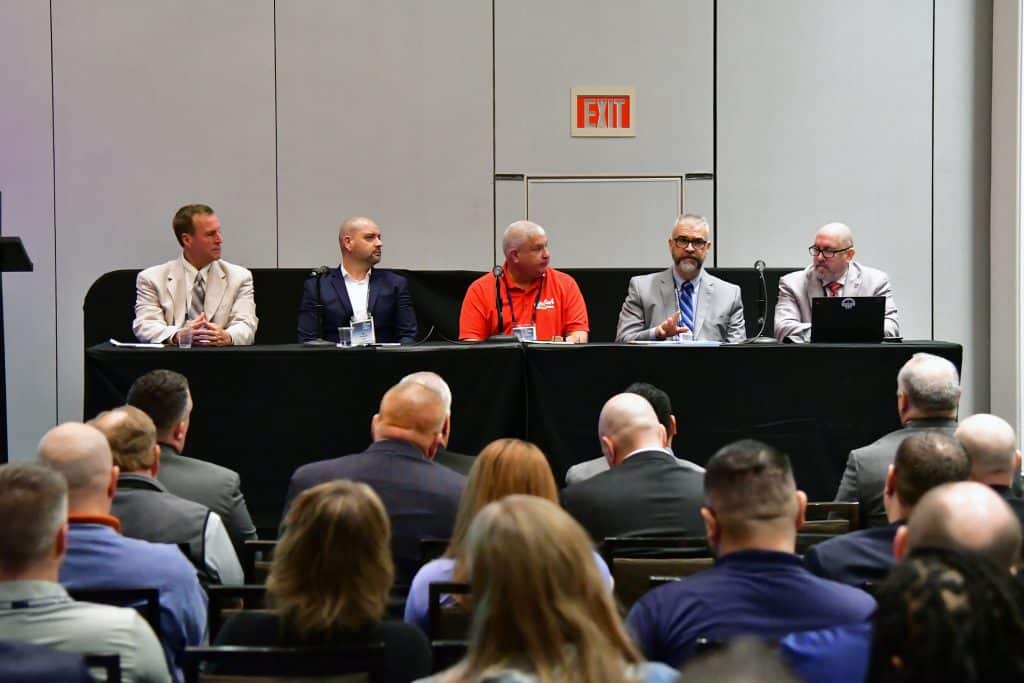
General President Coleman, SMART General Secretary-Treasurer John Daniel, SMACNA President Hill, Immediate Past SMACNA President Tom Martin and SMACNA CEO Frank Wall discussed the state of the industry and took audience questions during a Partners in Progress leadership panel. Throughout the panel, one theme unsurprisingly took precedence: working together to solve problems and help locals continue to grow.
“It’s important to remember that not one of us can do it alone,” Hill said. “We can work together, and that’s true leadership.”
Having a strong relationship built on trust, communication and collaboration empowers local unions and contractors not only when it comes to issues like negotiations, but also when working proactively to win future gains for both employers and SMART members. That’s been evident in the two organizations’ work on megaprojects, retention and beyond. By planning together in lockstep for megaprojects years in advance, for example, locals and contractors met the challenge presented by workforce demands, megaproject management and foreperson training, to name a few.
“When we’re communicating well, we’re up to speed on trends. We know where future big projects might land, and that’s imperative,” said Martin.
Partnership also matters as SMART and SMACNA try to grow — geographically and membership-wise, but also in terms of new markets.
“We’ve got an obligation, a responsibility, to identify those markets and not just lean into them – we’ve got to jump into them,” said General Secretary-Treasurer Daniel. “We’ve got to find a way to work together to grow into those sectors.”
During the panel discussion and when answering audience questions, industry leaders covered a lot of ground. But the bottom line was put succinctly by General President Coleman.
“When there’s a good labor-management relationship in an area, their market share is high,” he concluded. “That’s a fact.”
Sheet metal leaders prepare for the future in breakout sessions
At every conference, Partners in Progress breakout sessions put the power of effective labor-management relationships on display. In 2026, attendees got the chance to take a variety of lessons home from fellow union leaders and contractors — helping secure the future for sheet metal workers across North America.
In the “Leveraging Technology and Partnerships for Industry Advancement” session, SMART Local 38 (Brewster, New York) Business Manager Michael Colombo joined Mark Treglio and Stacy Yuden, president and CEO, respectively, of the labor-aligned tech and communications firm NEP Services, as well as SMACNA Southeast New York Executive Vice President Alan Seidman. Working together, Local 38, SMACNA SENY and NEP Services used data mining and information technology for strategic political engagement, helping pass pro-worker state legislation in Connecticut in 2025.
Fire life safety is a crucial priority for local unions across SMART — both for the safety of communities and first responders, and because of the work it creates for union sheet metal workers. In “Getting Fire Life Safety Regulations Done — A Practical Playbook,” Local 49 (New Mexico) Business Manager Isaiah Zemke, Tony Kocurek of Energy Balance and Integration, LLC, and Ronda Gilliland-Lopez of SMACNA New Mexico discussed how they worked together to win fire life safety standards in New Mexico.
“Knowing that this was an underserved or under recognized part of a building system to keep occupants safe and building owners safe, we had a lot of support from the fire fighters — union members, boots on the ground,” Zemke said, adding that the partnership with SMACNA helped overcome potential obstacles in the state legislature.
“The work doesn’t end once the law is passed,” he advised attendees. “You’re not done yet.”
Megaprojects have presented local unions and signatory contractors with extraordinary challenges and opportunities over recent years. SMART Director of Megaprojects Joseph Powell, Local 4 (Memphis, Tennessee) Business Manager Mike Thorne, representatives from Southland and Ventcon, and moderator Clark Ellis of Continuum Advisory Group engaged in a panel focused on the project management challenges unique to megaprojects. Collaboration, resource-sharing, consistent communication and coordination are key to helping local unions and signatory contractors meet the workforce challenges that megaprojects inevitably bring.
“At the IA level, we set up meetings with SMACNA, had routine meetings on a monthly basis — really trying to figure out what resources we could provide to locals,” said Powell.
In Labor-Management in Action, Local 280 (Vancouver) Business Manager Steve Davis and SMACNA-British Columbia Executive Director Jeremy Hallman discussed how fostering a true labour-management partnership has benefited the industry in the province, leading to growth for the local union, increased market share and efforts to find new training opportunities for members to help them gain more certifications. In a panel on clean rooms, meanwhile, SMART Canada International Rep. Scott McQueen joined SMART Director of Business-Management Relations Tom Fischbach and Kocurek of Energy Balance and Integration, discussing the massive (and growing) clean room market. In Ontario, McQueen reported, one megaproject alone required 1.5 million work hours on clean rooms.
Other breakouts focused on developing jobsite leaders, reclaiming residential market share, artificial intelligence on the jobsite and in the classroom, and more.
Keynote speakers energize attendees for the work ahead
Melissa StockwellMike Massimino
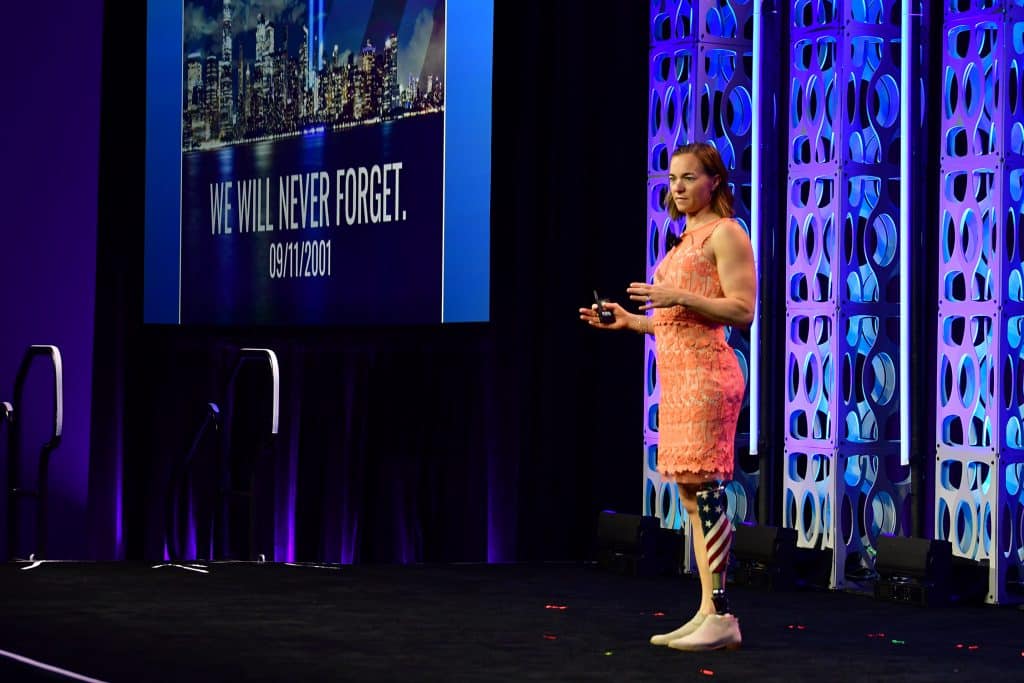
The conference’s opening keynote speaker, Melissa Stockwell, graduated from the University of Colorado in 2002 and was commissioned as a Second Lieutenant in the United States Army. In March 2004, she deployed to Baghdad, Iraq. Just three weeks later, a blast from a roadside bomb struck her Humvee, causing the loss of her left leg above the knee.
Rather than let tragedy slow her down, Stockwell made history. In April 2008, she became the first Iraqi War veteran to qualify for the Paralympics. She competed in three swimming events and was selected by her fellow Team USA athletes to carry the American flag in the closing ceremonies. After Beijing, Stockwell turned to the sport of Paratriathlon and is now a three-time World Champion.
“They took my leg, but they didn’t take my life,” she told Partners in Progress. “My life would go on. The only difference was, I would wake up, put my prosthetic leg on, and go about my day.”
Perseverance, resilience, refusing to give up — local union leaders and signatory contractors need to practice such traits every day. Stockwell presented to conference attendees on “The Power of Choice,” relating her story to the challenges and accomplishments SMART and SMACNA members face in the sheet metal industry.
“You are a team … as you’re learning this week, together, there’s even greater results,” she said, adding: “The next time something doesn’t go your way … how are all of you going to join me in exercising your daily power of choice?”
Closing keynote speaker Mike Massimino is a former NASA astronaut, a New York Times bestselling author and a Columbia University professor. A spacewalker on the final two Hubble Space Telescope servicing missions, Massimino and his crews traveled faster and higher than any other astronauts in the 21st century.
“It was designed to be worked on by astronauts. But there’s a lot of sheet metal on this thing,” he said of the Hubble.
For his first mission to space, Massimino recalled walking up to the spaceship as it made extremely loud, guttural noises, and thinking to himself: “Maybe this wasn’t a good idea.”
That’s when Massimino relied on what he called the three trusts: Trust your tools. Trust your training. Trust your team. That gave him the courage to get inside the spaceship for the first time and, looking at planet Earth from space, experience the most beautiful sight he had ever seen.
On his second mission to Hubble, Massimino and his team were taking on an extraordinarily complicated objective: repairing the Space Telescope Imaging Spectrograph in space. Instead of simply removing and replacing a component, Massimino would be fixing a piece of equipment that was painstakingly put together in a clean room. He needed to access a panel that had 111 small crews holding it in place, each with a washer; more than 100 new tools were invented to complete the task.
Massimino had a backup plan for every single part of the mission — besides a simple handrail that needed to be moved aside. When he looked to remove the final screw holding the handrail in place, it was deformed into a gnarled piece of metal that could not be unscrewed. The mission was in jeopardy.
That’s where trusting his team came into play. Thanks to a stroke of inspiration from an engineer back on the ground in Mission Control, Massimino went for brute force: ripping the rail off the telescope by hand. It worked, and that imparted a valuable lesson.
“We can’t always solve problems on our own — remember there’s a control center for you,” he told sheet metal leaders. “There’s people on your team that can help. And maybe more important, you can be that Mission Control for others.”
Massimino closed with an image of a star field, one with 10 million stars. He called it “the big picture.”
“What you’re doing is not easy, and it’s met with challenges, changes,” he told Partners in Progress. “But when you hit those bumps in the road, I would encourage you to persevere, think about the big picture and keep doing what you’re doing.”
On February 23, 2026, workers at SPX Cooling Technologies, LLC in Springfield, Missouri, voted to ratify their first contract as SMART members. The three-year agreement includes a $1,500 ratification bonus, wage increases of over 11%, the preservation of health and retiree benefits and just cause protection against unfair discipline.
The victory came from workers who were organized to stand together and utilize labor’s oldest and most powerful weapon: the strike! On two different instances in November 2025, SPX workers struck, first for one day to protest the company’s removal of low-rise chairs from the workplace, and then once more for two days to protest the company’s hostile and callous response.
“We went to the picket line. We had our signs out there. We let the company know that this is not acceptable to us,” said SPX employee and SMART Local 208 member Andrew Stracke.
“The majority of our shop is looking for union representation”
SPX Cooling Tech employees at the Springfield facility, which opened in 2024, manufacture cooling towers and air-cooled heat exchangers; cooling towers, in particular, are in high demand as investment increases in data centers. The components that SPX employees manufacture are vital for the continued boom in data center construction.
Workers started to talk about organizing in response to various issues in the shop. Stracke, a Local 208 negotiating committee member who has worked at SPX since 2024, alleged instances of favoritism, different wage rates for different people, inconsistent discipline policies and more.
“I was actually the one that placed the call to [a union] office up in St. Louis,” Stracke recalled. “And I felt like the first thing I told them was, ‘look, the majority of our shop is looking for union representation.’”
“Me and Andrew, we were just kind of talking with each other one day about, you know, the unfair working conditions that we were experiencing at the time at the shop. We were just kind of trying to figure out what we could do about it. It was just regular old employees,” added fellow SPX worker and negotiating committee member Wyatt King. “One employee by yourself, you know, you’re not going to have a lot of weight behind you, but when you organize into a union, you can actually address unfair working conditions and unfair wages.”
Members demand a change
The workers at SPX Cooling Technologies in Springfield overwhelmingly elected SMART Local 208 to represent them in a July 2025 National Labor Relations Board (NLRB) election.
But despite the workers’ strong support for the union, SPX initially opposed their organizing. The day after workers won their election, management took away the low-rise chairs that workers used on the job, forcing them to work on their knees.
“I was just astonished … everybody was just kind of like, ‘well, you know, it’s clear retaliation towards electing a union to represent us,’” said King. “I mean, some of those guys in the shop are 60 years old working on the concrete, on their knees all day.”
On Friday, November 7, workers engaged in a one-day grievance strike over the removal of chairs. The strike was covered by the Springfield News-Leader newspaper.
“Any concerns that we’ve raised, whether it’s about chairs, retaliation, harassment, intimidation — they’ve just stonewalled us on all of it. There’re no discussions,” SMART Central States Regional Production Council Organizer Richard Harris said in an article in the News-Leader. “We should be able to sit down and talk about these issues and resolve them. We shouldn’t have to resort to this.”
Workers attempted to serve their strike notice on an SPX supervisor. But the supervisor refused to meet with them. Instead, a woman workers identified as the supervisor’s wife pulled up to the picket line in a white sedan with two anti-union signs taped to her back windows. One read: “F**k the Union.” The other: “Do what lil b*tches do best while down on your knees!!!” She proceeded to drive back and forth in front of the picket line, shouting profanities at the workers and threatening to have them arrested.
The week after the strike, workers submitted a harassment complaint with SPX’s General Counsel in Charlotte, N.C., regarding the signs. The complaint was signed by nearly everybody in the shop. In the meantime, management continued to threaten workers for participating in the strike. One worker who took part in the strike was verbally reprimanded for “not walking with a purpose.”
Unsatisfied with SPX’s handling of their harassment complaint, workers struck a second time on November 24 and 25. Picket signs read: “Walk with purpose! We strike today!”
Direct action gets the goods
Seasoned union leaders know how difficult first contract campaigns are. The legal consequences for bargaining in bad faith are next to nothing — a notice posting and promise not to do it again — so many employers adopt a strategy of endless delay. According to recent studies, 63% of first contracts fail to settle in one year, and 43% are still unresolved after two. The average time from NLRB certification to first contract — if one is ever reached — is 465 days!
How, then, did SPX workers manage to win their first contract in under six months? By recognizing the structural power they have within the data center economy, and by taking direct action to resolve their grievances. The strikes had an immediate effect on SPX’s demeanor at the bargaining table. Company representatives freely admitted the top priority was getting units assembled and out the door, which the strikes interfered with. Before the strikes, the company was agreeing to meet to bargain once every six weeks; after the strikes, the parties were meeting six days per month.
Collective strength and common ground
In the following months, Local 208 members say, the workers stood strong. And when they voted to ratify their first contract as SMART members, their agreement included a clause requiring the company to provide low-rise chairs.
“We’ve held so many meetings with the bargaining unit, and the participation has been outstanding,” said Stracke. “We have a really high percentage of people that work in the facility that are completely on board. They’re completely invested, they’re excited to see what working with this union and negotiating a contract, what could come of it. And already we have seen the union step up whenever they needed to step up, and give us answers when we need answers.”
In turn, the negotiating committee reports, the relationship between workers, Local 208 and management has started to improve.
“I think we’re in the middle of establishing a great line of communication and work relationships between the company, the employees and the union, and hopefully, this is a relationship that we’re able to keep going even beyond our first contract,” said Logan Hirst, SPX worker and Local 208 negotiating committee member.
Other members of the negotiating committee are similarly optimistic about the road ahead — largely because, as SMART members, they’re not just individuals at work anymore. They’re part of something bigger.
“We’re not just bringing up our complaints to management, and they just do whatever they want with it. We actually have a voice, we have a lot of weight behind us now, and they actually have to listen to us,” said King. “They have to negotiate fairly. … We’re all standing together to make real change in our workplace.”
The SMART difference:
Workers at SPX Cooling Technologies, LLC in Springfield, Missouri, voted to ratify their first contract as SMART members in February.
The three-year agreement includes a $1,500 ratification bonus, wage increases of over 11%, the preservation of health and retiree benefits and just cause protection against unfair discipline.
On two different instances in November 2025, SPX workers struck, first for one day to protest the company’s removal of low-rise chairs from the workplace, and then once more for two days to protest the company’s hostile and callous response.
The average time from NLRB certification to first contract — if one is ever reached — is 465 days. SPX workers won their first contract in under six months.
Last summer, I had the chance to take part in the first-ever Belonging and Excellence for All (BE4ALL) Town Hall at my home local in Cleveland, Ohio. Together with SMACNA Past President Tom Martin and a packed house of Local 33 members, plus members from across North America who joined via livestream, we talked all things BE4ALL: What it is, why it’s important, and how it benefits every single member of our union.
Because that’s the thing, brothers and sisters. BE4ALL is what our union is all about. It’s in the name: Belonging and Excellence for ALL. That belonging is what every member who joins our union deserves: We want to have the opportunity to work, earn a good living and enjoy a long, fulfilling career in our industry. And that excellence is what we pride ourselves on as SMART members. Craftsmanship, hard work and standing up for one another, from the jobsite to the union hall.
Those are the values that BE4ALL is working to bring to every single jobsite, workplace and member across the United States and Canada. Making sure every single one of us feels welcome when we walk onto the job, go to our local union meeting, attend classes at the training center and beyond.
In other words, BE4ALL is about solidarity. It is about our values as SMART members: having each other’s backs, bargaining collectively to win the better pay, benefits and lives that we and our families deserve.
But it’s also more than that. BE4ALL is strategic. It’s about making sure SMART locals and our contractors — the UNIONIZED sheet metal industry — can grow and take on more work in every single part of North America. For our union to thrive, for our pensions to stay secure and for our collective bargaining power to grow, we need to recruit and retain any American or Canadian ready to work hard and commit to SMART.
That is what BE4ALL is all about. And we all have a role to play. There are so many different ways to get involved with BE4ALL. You can attend the BE4ALL Learning Journeys online (or watch the recordings afterwards). You can participate in BE4ALL’s challenges, emailed to members regularly. You can browse the various Toolbox Talks and other resources on the BE4ALL website, beforall.org.
Most importantly, you can do your part to make sure your brothers and sisters feel welcome at work and in our union. That’s how we secure our future.
On December 22, 2025, the Local 5 (East Tennessee) SMART Army hosted a food drive for the local community, putting our union’s values into practice.
“The idea came from one of our first-year apprentices, Briley Lawson,” said Local 5 Organizer Hunter Gossett. “The local donated $1,000 worth of food, and the membership stepped up in a big way: We were able to give food to 148 individuals for the holiday season.”
That’s the SMART Army in action: building better communities.
In Kentucky, SMART Local 110 members and military veterans are working on a project that means something extra: a massive new Veterans Affairs (VA) Medical Center that will provide health care for those who served.
“This project right here was very personal to me,” said Andrew Judd, Local 110 member, United States Marine Corps veteran and foreman on the project. “I don’t have the [money] to just give millions and millions to veterans all the time, so I can [give back] the best way that I know how … and that is to make sure that me and my fellow veterans, we all have a nice hospital here.”
The new facility, located in east Louisville, is about 80% complete, according to the United States Army Corps of Engineers. Construction on the $970 million project is expected to conclude by the end of 2026, with the medical center open and serving veterans by 2027.
For David Hale, a Local 110 member, superintendent and Army veteran who served for four years “in Gulf Storm … 11 Bravo Infantry,” the Louisville facility is the second VA project he’s worked on.
“I actually worked on the Lexington VA for two years, about 10 years ago,” Hale said. “Neither facility we have [in Kentucky] is up to snuff, in my opinion, so I think this is going to be great for all the veterans.”
Judd agreed, noting that the ability to be on-site during construction helps him try to ensure the facility is well-suited to meet veterans’ needs.
“Being on the front line, watching it go up, I can see things that I wouldn’t particularly like … and try and get something that I wouldn’t be happy about, and I know other veterans wouldn’t be happy about, trying to get it changed ahead of time,” he explained.
Veteran apprentices learn on the job
Sheet metal veterans aren’t just helping build the new VA Medical Center. For military veterans who are newer to the trade, this project is helping with the transition from service to civilian life.
Local 110 apprentice James Thomas Gray served with the 223rd Military Police Company, Kentucky National Guard, for six years.
“As a civilian and a veteran, I didn’t know how to get into the trade,” he said. “I didn’t know who to talk to, where to go. I didn’t know there were union halls, things like that, so I just joined a random nonunion company.”
He started working on an elementary school job alongside a predominantly unionized workforce. He heard constantly about the opportunities: the pension, the insurance and everything else that defines SMART membership. Very shortly after, he joined Local 110.
Now, Gray has been helping build the new VA Medical Center, which promises to serve veterans such as himself and his twin brother. Like the other SMART veterans on the job, he said the work he’s been doing for more than a year carries extra importance.
“It means a lot to me, because I have friends and family that are more than likely going to be going there one day,” Gray said. “So I like knowing that they’re going to have a place to go that’s big enough to serve everybody.”
From The Craftsman, the official publication of SMART Local 20 (Indiana)
Joseph B. Thurmond, a longtime Indianapolis SMART member, spent his career paving the way for all of us today. Joe joined Local 20 in 1941, working for two years before being drafted into the military. He had the honor of serving two years in the 94th Infantry Division under General Patton.
In 1944, the 94th Infantry landed in France and immediately got to work containing a staggering 60,000 German troops. After that success, the division pushed deeper into Europe, carrying out multiple military operations until the war ended in the mid-1940s. Joseph later joined the liberation forces in Czechoslovakia, helping secure liberated areas and working to restore order in the region.
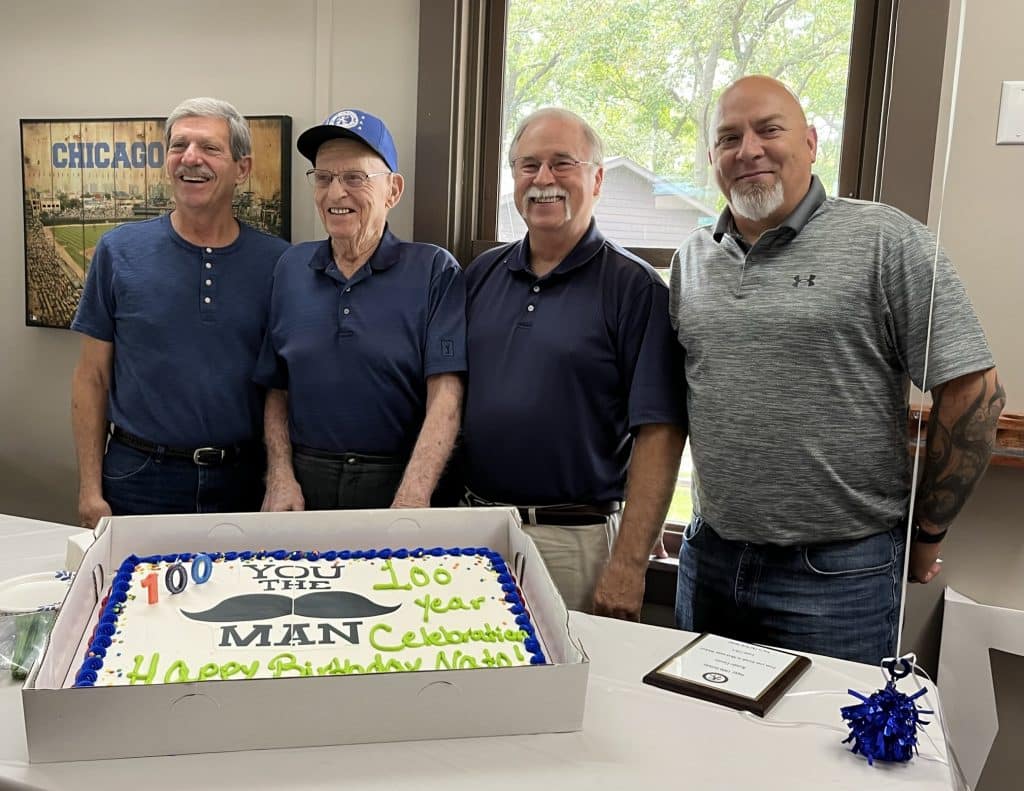
Pictured, left to right: Business Representative Brad Hayes, Joseph B. Thurmond, Business Representative Shawn Reels and Business Manager/ Financial Secretary-Treasurer Trent Todd
When he returned home, Joe went right back to work as a sheet metal worker, dedicating another 44 years to the trade. He did a little bit of everything but found a special talent and enjoyment in interior metal panel work and acoustic panel installations. Throughout his career, Joe passed down invaluable knowledge to apprentices and fellow journeypersons, but what he valued most was a solid work ethic.
That work ethic started young, splitting wood with his dad and uncles. When asked what advice he’d give to young tradespeople today, Joe kept it simple: “Work hard. If you are working and being paid for eight hours, then give eight good hours of work.” He believes the strongest attribute of a successful sheet metal worker is a solid work ethic, something that’s hard to teach but essential to learn.
Hard work has never been a stranger to Joe. At 99 and a half years old, he still enjoys splitting wood almost daily for his fireplace. His life is full of inspirational moments, but one achievement stands out: Joe recently received recognition for maintaining 84 consecutive years of membership in good standing with Local 20.
To put that in perspective, the year Joe joined our union was the same year M&M’s hit the market, aerosol spray cans were invented, and the first fully programmable computer was developed. Today, Joe is the second-oldest member in the country and holds the longest continuous membership in good standing of anyone nationwide, truly a one-of-a-kind distinction.
Of course, we could talk about his bravery during the war or his love of drag racing his Chrysler New Yorker, but we felt highlighting his record-setting membership was something every member could relate to and respect. His story is proof that the long days in the heat and brutal days in the cold are stepping stones toward a hard-earned and rewarding retirement.
Joe has been retired since 1988, enjoying an impressive 38 years of retirement. We hope this story can inspire young members in the trade today. We thank Joe for his unwavering support, his decades of mentorship and the priceless knowledge he’s shared. He is a shining example of the kind of union member we should all strive to be. We wish him many more years of well-deserved retirement and good health, and we’re honored to share his story with the membership.
In the summer of 2025, SMART Local 170 (Pico Rivera, California) recognized and celebrated the incredible career and lasting impact of Mario A. Vega, who retired after 42 years of dedication to SMART as a member, leader and strong advocate for the unionized production and manufacturing industry.
Left to right: SMART Regional Organizing Director Manuel Gonzalez, Local 170 Dues Administrator Vanessa Medina, Maria Vega, retired Local 170 Business Manager Mario Vega, Local 170 Business Manager Roberto Torres-Muniz and Gloria Rodelo, Local 170 office manager
Brother Vega joined Local 170 in 1983. Two years later, he was appointed a shop steward at Simpson Strong Tie. His commitment soon earned him the trust of the membership, which elected him, in 1990, to both the Local 170 Executive Board and as a trustee of the Local 170 Group Insurance Benefits Trust.
On April 1, 2015, Vega became a Local 170 business representative, and after two years, he was elected to serve as the local’s business manager and financial secretary-treasurer. From then until his retirement, Brother Vega devoted himself to organizing, advocating and empowering his union brothers and sisters as business manager. His leadership helped secure fair wages, strong benefits and dignity on the job for countless members.
Throughout his career, Vega has been more than a leader in our union. He has been a mentor, a friend and a source of inspiration. His contributions have shaped not only our organization but also the lives of countless colleagues and workers in the production industry.
“As Mario moves into this well-earned chapter of his life, we want to thank him for all he has given and wish him and his wife, Maria, health, joy, relaxation and new adventures in retirement,” the local wrote. “Congratulations, Mario! You have truly made the difference at SMART Local 170 — and you will be deeply missed. On behalf of the entire local, we sincerely congratulate you on your retirement. Your contributions have been invaluable, and your legacy will endure in the history of our organization.”